16 US tech stocks fell 11% to 36% this week, and why each one did: six beat earnings and sank anyway, six never reported (plus a prompt)
Why 16 US tech stocks fell 11–36% in late October: six beat earnings and sank anyway, six never reported and got dragged down. Table and prompt included.
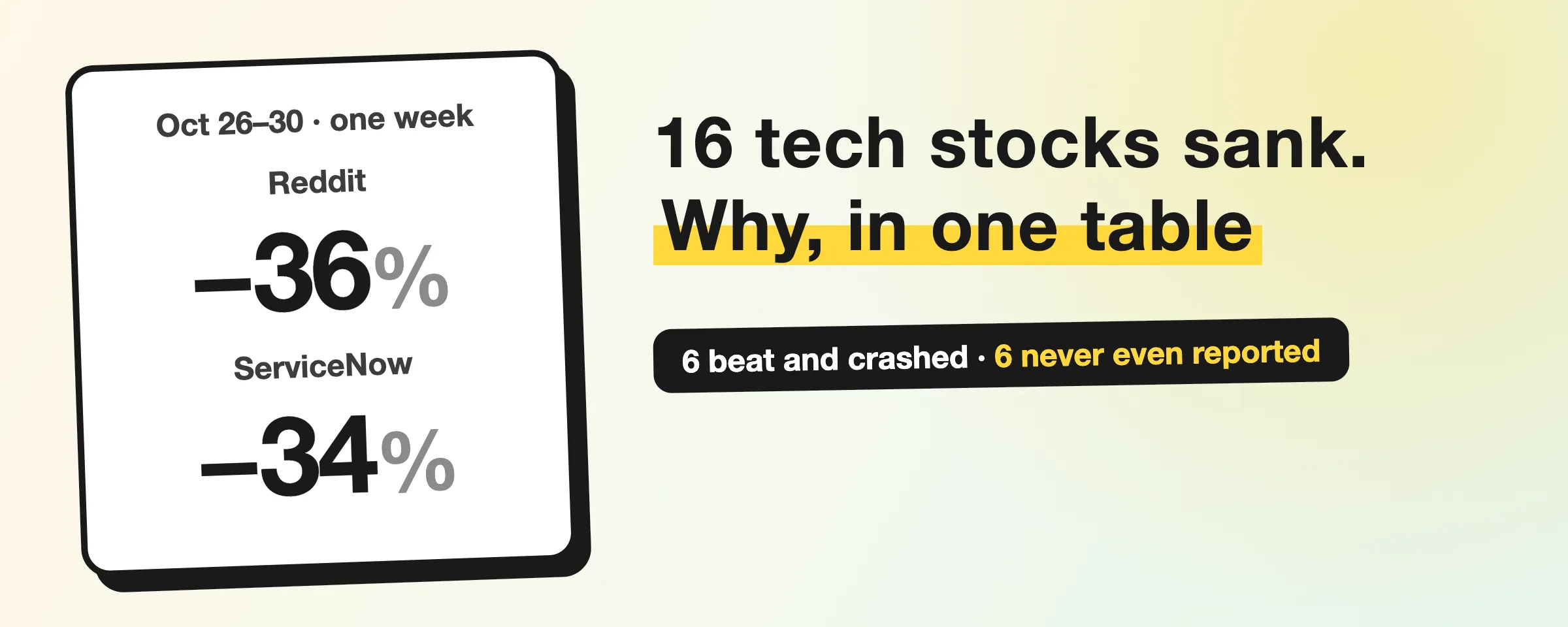
US tech had a rough week (October 26 to 30). Reddit fell 36% on the week, ServiceNow 34%, and Intel lost 29% in a single day on Friday. I went through 16 of the week’s big tech decliners one by one. Why each fell, in plain English:
- Six beat their numbers and crashed anyway. ServiceNow, F5, Fortinet, Intel and Reddit all reported quarters ahead of expectations and fell on what comes next: slowing growth, or guidance below what the market wanted. Teradyne even guided next quarter above expectations and still dropped 11% with the chip stocks.
- Six didn’t report at all and still fell more than 10%. Atlassian, HP, HubSpot, Cloudflare, Datadog and AppLovin had no company news big enough to explain the drop. Their worst days line up with a peer’s blowup or Friday’s selloff.
- Friday was the worst day of the week. Intel said its PC chip sales would drop by a fifth next quarter, and the Nasdaq fell 2.9%, its worst day since June. Chip stocks had gained 9% from Monday to Wednesday and gave back 8% on Friday alone.
- When a stock tanks, first work out which kind of drop it is. At the end there’s a table of the three kinds and a prompt: give it to an AI that can search the web, and it will find out why a stock fell and which kind it is.
| Stock | Week | Why it fell | Kind |
|---|---|---|---|
| Reddit (RDDT) | −36.4% | US users shrank and next-quarter guidance came in light; the CEO said Google’s switch to AI answers cut its search traffic | Own news |
| ServiceNow (NOW) | −33.9% | Guidance for contracted next-year revenue growth missed; fear that AI means companies buy fewer seats | Own news |
| F5 (FFIV) | −25.7% | Beat the quarter, guided next fiscal year to 8–9% growth; revenue from customers’ hardware refresh falls in the back half of next year | Own news |
| Fortinet (FTNT) | −24.4% | Beat the quarter but cut its full-year service revenue guidance; growth slowed from 26% to 20% | Own news |
| Intel (INTC) | −24.4% | Next-quarter revenue guidance about $1.5B below expectations; PC chips down a fifth | Own news |
| Twilio (TWLO) | −21.7% | Next-quarter growth guided down from 16% to 11–12%, with lower profit than this quarter | Own news |
| Atlassian (TEAM) | −15.8% | No report; fell with ServiceNow and in Friday’s selloff | Dragged down |
| HP (HPQ) | −14.4% | No news; fell almost 10% on Friday after Intel said PCs won’t sell | Dragged down |
| Marvell (MRVL) | −14.1% | Reported talks to buy Lumentum for about $83B in stock, diluting shareholders | Own news |
| Cloudflare (NET) | −13.8% | No report; fell Friday with software and AI cloud stocks | Dragged down |
| HubSpot (HUBS) | −13.3% | No news; five straight down days with software | Dragged down |
| Datadog (DDOG) | −12.7% | No news; fell 11.5% on Friday alone | Dragged down |
| Alphabet (GOOGL) | −12.6% | Profit missed, search ad growth slowed to 12%, data center spending turned free cash flow negative | Own news |
| AppLovin (APP) | −12.2% | No news; flat Monday to Wednesday, down 10% on Friday | Dragged down |
| UMC (UMC) | −11.7% | Solid quarter; most of the drop came Thursday and Friday with chips | Fell with the sector |
| Teradyne (TER) | −11.2% | Beat the quarter and guided above expectations; then fell with chip stocks | Fell with the sector |
Guidance is what a company says about next quarter or next year: roughly how much revenue, roughly what margin. A stock price pays for the future. Once this quarter’s results are out they’re history, and Wall Street had them mostly priced in. The guidance is the part nobody had pinned down. The Intel and ServiceNow piece walks through this in detail.
1. Software: decent results, sunk by next quarter
Software took the worst of it. The software ETF (IGV) fell 5.7% on the week, while the S&P 500 lost just 0.56%.
- ServiceNow −33.9%. Software for big companies’ internal IT tickets and approval workflows, mostly billed per user seat. It fell 27% on Thursday, its worst day as a public company. The quarter hit its targets. What slipped was cRPO, think of it as next year’s subscription fees already signed: it grew 21% this quarter, guidance for next quarter is 18.5%, and Wall Street wanted 19.4% to 20%. The fear underneath: if AI agents can close tickets on their own, why would companies keep buying so many seats?
- F5 −25.7%. Network gear that balances traffic for websites and apps and blocks attacks. It reported Tuesday after the close, revenue of $917 million against about $885 million expected, and still fell 20% on Wednesday. The problem is next year: it guided its new fiscal year to 8% to 9% revenue growth, down from 11%. The CFO said revenue from customers replacing hardware falls in the back half of next year, and pricier components are squeezing margins. The stock was up 80% this year, and Piper Sandler cut it to Neutral.
- Fortinet −24.4%. Corporate firewalls. It reported Wednesday after the close: revenue of $2.08 billion, up 20%, ahead of expectations, and it raised full-year revenue guidance. It still fell 20% on Thursday. Fortinet makes money two ways: selling the firewall box, and the service customers renew every year after it’s installed (threat updates, support). The market cares most about the second, because it recurs, and Fortinet cut its full-year service revenue guidance from $5.18–5.22 billion to $5.15–5.17 billion. The CFO called it timing: large customers buy the boxes first and switch on the services later. The stock was up 60% this year, and Bank of America cut it to Neutral.
- Twilio −21.7%. The API apps use to send verification texts and make calls; plenty of the codes you get come through it. It reported Thursday after the close and fell 15% on Friday. Excluding acquisitions it grew 16% this quarter and guided next quarter to 11% to 12%. Next quarter’s operating profit, $300–310 million, is also below this quarter’s. The press release doesn’t say why things slow down.
The other five didn’t report this week and had no company news big enough to explain the drop. Each one’s worst day lines up with someone else’s bad news:
- Atlassian −15.8%, maker of Jira and Confluence. It fell 7.3% on Thursday, the day ServiceNow collapsed, and another 6.1% on Friday.
- HubSpot −13.3%, marketing and customer software for small and midsize businesses. No earnings this week, and I found no downgrade or company news; it fell five days straight, 5% on its worst day. It reports November 4.
- Cloudflare −13.8%, website acceleration and network security. It fell 9.5% on Friday, when AI cloud stocks dropped together; CoreWeave and Nebius each lost about 10%. It had jumped 7% the Friday before, so part of this week was giving that back.
- Datadog −12.7%, which watches companies’ servers and code for problems. It fell 11.5% on Friday alone.
- AppLovin −12.2%, an ad platform for mobile games and apps. It barely moved Monday to Wednesday and fell 10.4% on Friday.
Two worries weighed on software as a whole. ServiceNow’s report revived the question of whether AI means companies buy fewer software seats. The other is Big Tech’s AI spending: Microsoft trimmed its 2026 capex forecast from $175 billion to $170 billion, and Alphabet spent $51.4 billion on data centers in one quarter and went cash flow negative. Cloud stocks that live off AI spending wobbled with both.
2. Intel, chips and hardware: one Friday wiped out the week’s gains
Chip stocks rose from Monday to Wednesday, with the chip ETF (SOXX) up 9% in three days. They slipped 1.6% on Thursday and fell 8.2% on Friday, ending the week down just 1.4%. Most of the drops below came on Thursday and Friday.
- Intel −24.4%. It reported Thursday after the close and fell 28.6% at Friday’s close, from $92 to $66 in one day. It guided next quarter’s revenue to $15–16 billion against about $17 billion expected, and earnings per share to $0.25 against $0.43. It expects global PC shipments down 12% this year and another 10% next year: AI servers are taking the memory and PCs aren’t selling. The details are here.
- HP −14.4%. PCs and printers. HP said nothing this week and fell 9.6% on Friday, right after Intel said PCs won’t sell. Dell fell 10.8% the same day.
- Marvell −14.1%. Networking chips for AI data centers, plus custom AI chips for the big cloud companies. After the close on Wednesday, Bloomberg reported it was in advanced talks to buy Lumentum, which makes optical components, for about $83 billion. That’s more than a third of Marvell’s own market value, and it would pay entirely in stock. Paying in stock means issuing a large block of new shares, so each existing share gets a smaller slice of the profit. That’s dilution. Marvell fell 13.2% on Thursday and another 10.1% on Friday with the chips. No deal has been announced.
- UMC −11.7%. A Taiwanese foundry that makes chips for other companies, mostly on mature, less advanced processes. Its third-quarter report on Wednesday was solid: revenue of NT$74.24 billion, up 25.6% from a year ago, a 34% gross margin and 92% utilization. Most of the drop came Thursday (−4.1%) and Friday (−7.5%), alongside the chip stocks.
- Teradyne −11.2%. Chip testing equipment; chips go through its machines to check they work. It reported Tuesday after the close: revenue of $1.31 billion, up 70%, earnings per share of $2.29 against about $2.08 expected, and next-quarter guidance above expectations too. It fell only 3.2% the day after the report. Two-thirds of the week’s drop came Thursday and Friday.
Three things hit chips at once on Friday. Intel warned about weak PCs and short memory supply. Japanese memory maker Kioxia’s forecast missed, a day after Samsung missed. And two Fed officials said more hikes are coming: Musalem said tightening is needed “soon,” and Dallas Fed President Logan said at least two more hikes are needed. AMD fell 10.9% that day and Qualcomm 11.1%.
3. Google and AI search
- Alphabet −12.6%. It reported Wednesday after the close and fell the whole week’s amount on Thursday. Profit missed. Search ad growth slowed to 12% from 19% and 17% in the two quarters before. It spent $51.4 billion on chips and data centers in one quarter, free cash flow went to −$9.1 billion, and it said capex will “increase significantly” next year. The line-by-line breakdown is here.
- Reddit −36.4%. It reported Thursday after the close and fell 29% on Friday, its worst day since its 2024 IPO. Revenue was $895 million, up 53% and ahead of expectations. But US daily active users were 50.7 million, down 2% from a year ago, against 53.5 million expected, and it guided next quarter’s revenue to $1.00–1.03 billion against $1.05 billion expected. CEO Steve Huffman told CNBC that day that search traffic from Google was “down meaningfully in this quarter” because of Google’s “shift to AI mode and AI overviews.”
You used to google a problem, see a Reddit thread in the results and click it, and that click was Reddit’s traffic. Now Google’s AI writes the answer at the top of the page, and plenty of people read it and leave without clicking. Reddit also plans to test requiring a login to read, starting in the fourth quarter outside the US. The same week, Google’s own search ads slowed, and Reddit, which relies on Google for traffic, reported less of it.
4. Why a stock fell: three kinds (bookmark this)
| Kind | How to spot it | This week | What to watch next |
|---|---|---|---|
| Own news | It reported earnings, guidance or other big news this week, and its worst day came right after | ServiceNow, F5, Fortinet, Twilio, Intel, Reddit, Alphabet, Marvell | Whether the next report’s guidance makes up the gap |
| Fine news, fell with the sector | It reported and the news was fine; it fell little that day and most of the drop came later with its peers | Teradyne, UMC | When the sector stops falling: SOXX for chips, IGV for software |
| No news, dragged down | No earnings or announcements this week; its worst day matches a peer’s blowup or a market selloff | Atlassian, HP, HubSpot, Cloudflare, Datadog, AppLovin | Its own next report: Datadog and HubSpot on November 4, Atlassian and Cloudflare on November 5 |
Of the six that got dragged down, Datadog, HubSpot, Atlassian and Cloudflare report next week, and their own numbers will say whether the drop was deserved. As for what happens after an earnings-day crash, I looked earlier at 61 of them across 8 big tech companies (not these 16): most kept falling the first week, and a month on, buying after the drop was no different from buying on any other day. That piece is here.
Prompt to paste into your AI
Use an AI that can search the web: Claude or ChatGPT with search turned on, or Codex started with codex --search. Fill in the ticker and the dates, then paste this:
Find out why a US stock fell sharply. Ticker: ______. Period: ______ (for example, the week of October 26–30, 2026). Search the web and give a source link for every point; if you can't find something, say "not found" and don't guess.
1. How far it fell over the period (from the previous trading day's close to the last day's close), in percent; which day it fell the most, and by how much.
2. Whether it had news of its own in the period: earnings, guidance, an acquisition, an executive's remarks, an analyst downgrade, regulation or a lawsuit. If so, give the date and whether it came before or after the worst day.
3. If it reported earnings: this quarter's revenue and EPS against analyst expectations; next quarter's or the full year's guidance against expectations; whether growth sped up or slowed from last quarter; how the company explains it.
4. On its worst day, how much its sector fell (IGV for software, SOXX or SMH for chips, the Nasdaq 100 for the market), and whether a peer had big news.
5. Classify it as one of three, with your reasons: A, own news (it fell most right after its own news); B, its own news was fine and most of the drop came with its sector; C, no news of its own, dragged down by a peer or the market.
6. The date of its next earnings report.
7. Sum up in three plain sentences: why it fell, which kind it is, and which date and which number to watch next. No buy or sell advice.
How I checked
- The weekly move runs from the close on Friday, October 23 to the close on Friday, October 30, using WhatsMoving daily closing prices. Cloudflare, Datadog and three ETFs (S&P 500, Nasdaq 100 and software) were checked against a second source.
- Company numbers come from each company’s earnings release and from CNBC, Motley Fool, 247WallSt, SiliconANGLE and Yahoo Finance. Expectations are the analyst consensus as reported in the media, and sources differ.
- Marvell’s talks with Lumentum come from Bloomberg’s report; neither company has announced anything. The Reddit CEO’s words are from his October 29 CNBC interview. The Fed officials’ remarks come from Reuters and Wall Street Journal headlines.
- No outlet named a reason for the six I filed under “dragged down”; that call is mine, from matching dates. On Monday, Cloudflare disclosed a bug: from late August to early September, its AI service returned other customers’ data 155 times, fixed in September. Its stock was roughly flat across Monday and Tuesday.
- The list covers these three groups, not every big decliner: Roblox fell 18.7% the same week and FICO 12.8%, and neither fits here.
- This is a roundup and not investment advice. If I got something wrong, tell me in the comments and I’ll fix it.