Intel and ServiceNow beat their own guidance and still lost a quarter of their value: the problem is the next-quarter line (plus a prompt)
Why Intel and ServiceNow sank after Q3: PC chips down 20%+, memory going to AI servers, cRPO growth slowing to 18.5%. With a 6-line checklist and a prompt.
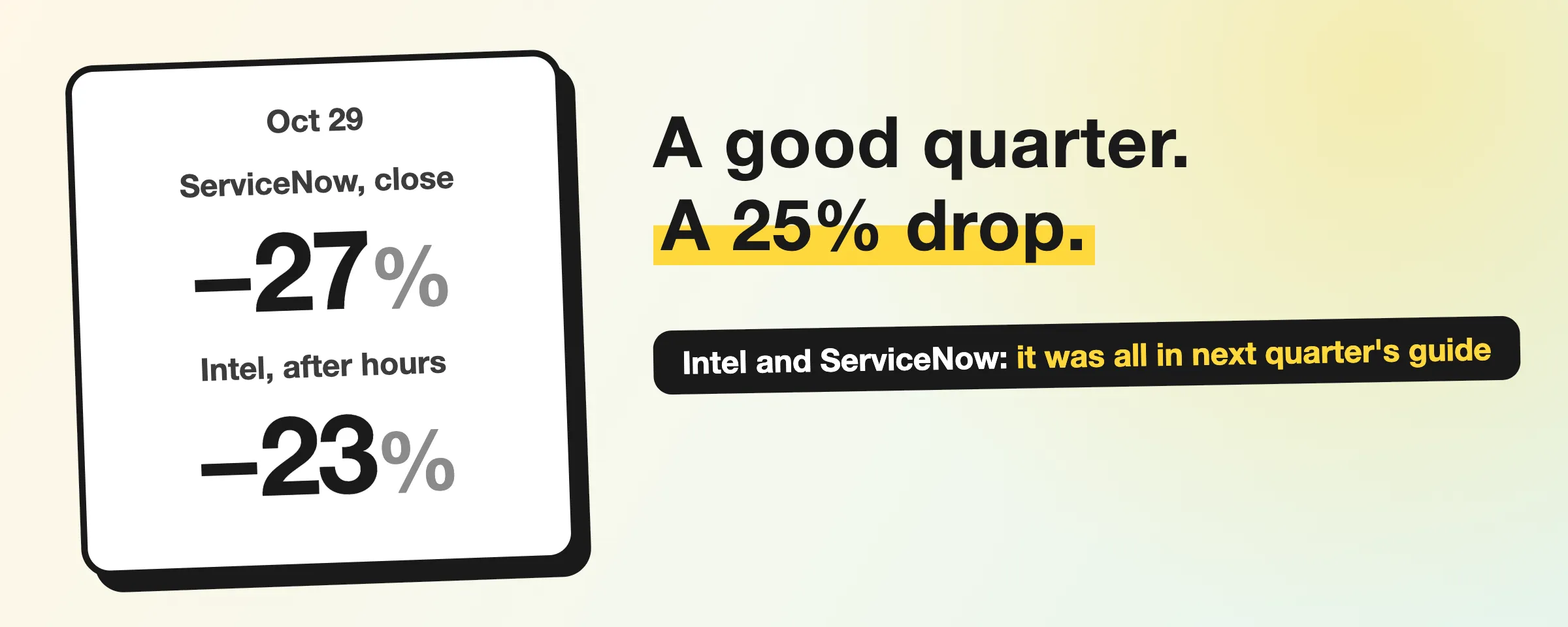
Two US companies reported solid quarters this week, both ahead of their own guidance, and both stocks lost about a quarter of their value. ServiceNow fell 27% in a day, its worst day in 14 years as a public company. Intel fell 23% after hours, about $110 billion gone overnight. Both tripped on the same line: guidance for next quarter.
I read both companies’ 8-K filings with the SEC and both earnings calls in full. The plain-English version:
- Both quarters were solid. Intel’s Q3 revenue was $16.5 billion, up 21%, and earnings per share came in at $0.52 against roughly $0.41 expected. ServiceNow’s subscription revenue grew 21%, and its annual contract value target for AI products went from $1 billion at the start of the year to $1.7 billion.
- Intel: it can’t make AI server chips fast enough, and PC chip sales will drop a fifth next quarter. It guided next quarter’s revenue to $15 billion to $16 billion, against about $17 billion expected, and gross margin falls from 44% to 38%. Three things hit at once: AI servers are taking the memory, PCs aren’t selling, and its Israel factory had an accident.
- ServiceNow: growth in a number called cRPO slows from 21% to 18.5%. cRPO is revenue already signed into contracts for the coming year. The company says it’s mostly early renewals and accounting rules. The market’s fear is that AI breaks the business of charging for software per user seat.
- The stock price pays for next quarter. At the end there’s a 6-line checklist for reading guidance and a prompt. Next time a company posts decent numbers and still crashes, hand the filings to an AI and it will find the line that did it.
| Intel (INTC) | ServiceNow (NOW) | |
|---|---|---|
| What it does | CPUs for PCs and servers; also makes chips for other companies | Software big companies use for internal IT tickets and approval workflows, mostly an annual fee per user seat |
| How far it fell | −23% after hours on October 29 | −27% at the October 29 close, its biggest one-day drop since going public |
| Market value lost | About $110 billion | About $42 billion |
| This quarter | Revenue +21%, profit better than expected | Subscription revenue +21%, ahead of its own guidance |
| Next quarter | Revenue $15 to $16 billion, vs. about $17 billion expected | cRPO growth 18.5%, vs. 19.4% to 20% expected |
| The company’s explanation | Israel factory accident, memory shortage, weak PC market | Early renewals, government customers, accounting rules |
| Still worrying | Free cash flow probably won’t turn positive next year | Whether AI means companies buy fewer seats |
1. Intel: server chips can’t keep up, PC chips set to drop a fifth
This quarter Intel posted its fastest data center growth in 15 years: its server chip unit (DCAI) brought in $7.3 billion, up 78% from a year ago. On the call, CEO Lip-Bu Tan said the demand comes from AI, and AI agents in particular use a lot of CPUs. In the press release he said: “Our immediate priority is to unlock additional supply to meet extraordinary demand for our Xeon family.” (Xeon is its server chip line.) The other half of the business is dragging it down.
- PC chip revenue will fall more than 20% next quarter. The PC chip unit (CCPG) brought in $8.1 billion this quarter, already 9% less than the quarter before. CFO David Zinsner expects global PC shipments to fall 12% this year and another 10% next year, with no “sustained recovery until memory availability improves and pricing begins to normalize.” PC makers are clearing out inventory fast, so this unit’s revenue will drop more than 20% again next quarter.
- AI servers are taking the memory. A September report from TrendForce, a Taiwanese research firm, says AI servers pay memory makers better, so they keep moving production to servers, and PC makers are stockpiling because they expect another shortage next year. IDC expects the average PC price to rise 17% this year. If you’re planning to buy a computer, this matters more to you than the stock price.
- The Israel factory accident costs $300 million in revenue outright. On October 14 an explosion at Intel’s factory in Kiryat Gat, Israel, killed two workers. The plant was shut for a while, and some server chips won’t ship in Q4. Intel’s own estimate is about $300 million less revenue in Q4 and 2 points off gross margin.
- Gross margin falls from 44% to 38%. Out of every $100 of chips sold, what’s left after the cost of making them goes from $44 to $38. EPS guidance is $0.25, against the roughly $0.43 the market expected, about 40% short.
- It will still burn cash next year. An analyst asked whether free cash flow (cash the business brings in, minus what it spends on factories and equipment) would turn positive next year. The CFO’s answer: “Probably not a dynamic where we’re going to have positive free cash flow next year.” That spending will rise sharply next year. In the first three quarters of this year Intel already raised about $22.6 billion by selling new stock.
Intel went from $36.9 to $92 this year, up 150%, and touched $142 in June. After a run like that, the market wanted to see the next step in an AI comeback for Intel, and a weak outlook hit hard. The last drop this big was August 2, 2024: −26% in one day, when Intel announced it would cut more than 15% of its staff and suspend its dividend.
2. ServiceNow: AI contract target up 70%, and its worst day since going public
ServiceNow runs the internal processes at big companies. When an employee reports an IT problem, asks for a laptop or sends something for approval, there’s a good chance ServiceNow is behind it. It mostly charges an annual fee per user seat, and charges extra for AI features.
- The quarter cleared the bar. Subscription revenue was $3.99 billion, up 21%, above the top of its own guidance. It raised its full-year subscription revenue guidance, and lifted its annual contract value target for AI products from $1 billion at the start of the year to $1.7 billion.
- The problem is cRPO. Short for current remaining performance obligations, it is revenue customers have already signed contracts for and that will be booked over the next 12 months. Think of it as next year’s membership fees, already signed. It grew 21% in Q3 at constant currency. The company guided 18.5% for Q4, and Wall Street had expected 19.4% to 20%. Software stocks largely trade on this line, so when it drops 2.5 points the market reads it as slower growth next year.
- The company’s explanation: mostly accounting and timing. On cRPO, CFO Gina Mastantuono said that “we saw strong early renewals in Q3 that contributed about half of the beat in Q3. Now that has a negative impact in Q4 because we pulled those deals out of Q4 and into Q3.” Government customers are choosing the on-premises version (run on their own servers) more often, which takes off 0.25 points. And contracts that customers can cancel at any time are, under the rules, left out of cRPO, which takes off another 0.5 points.
- Strip out acquisitions and growth is slower. This year ServiceNow paid about $7.6 billion for the cybersecurity company Armis, and late last year it bought Moveworks. Guggenheim estimates that, without acquisitions and currency swings, organic subscription growth (what the business it already had grew on its own) is 17% to 18%. At constant currency, which removes currency swings but keeps the acquisitions, it is 20.5%.
- What the market fears is something else. CNBC wrote that the results did little to ease fears that AI will upend the traditional software business. If AI agents can close the tickets on their own, will companies still need to buy so many seats? Asked about pricing on the call, CEO Bill McDermott said “the customer likes the predictability of the seat-based pricing model for their budgeting purposes.” Software stocks fell together that day: Atlassian −7.3%, Salesforce −4.6%, Workday −4.4%.
ServiceNow had already fallen 17.7% in April, its biggest drop since going public until this one. From its April 10 low of $81 the stock climbed back to $150, and this drop took it back to $110. Most analysts cut their price targets, but I haven’t seen anyone downgrade it from buy yet. Citi analyst Tyler Radke said the quarter lacked ServiceNow’s usual upside, and that growth won’t pick up again until next year.
3. Why decent results can still sink a stock this far
A stock price pays for the future. Once Q3 results are out they’re the past, and Wall Street had already estimated them closely. What nobody had pinned down was what each company would say about next quarter. That’s where both tripped:
- Intel’s revenue guidance for next quarter came in about $1.5 billion below expectations, with gross margin 6 points below this quarter’s.
- ServiceNow’s contract backlog growth came in 0.9 to 1.5 points below expectations.
That doesn’t look like much. But a stock price is many future years of profit discounted back to today, so the market takes a shortfall in one quarter and subtracts it from every year after. On top of that, both stocks had run up a lot, Intel 150% this year and ServiceNow more than 80% in six months, so expectations were high and the miss hurt more.
4. Decent results, big drop: check these 6 lines first (bookmark this)
| Line | Where to find it | Intel this time | ServiceNow this time |
|---|---|---|---|
| Next-quarter revenue guidance vs. expectations | “Outlook” or “Guidance” in the press release; expectations in financial news | $15 to $16 billion vs. about $17 billion | Subscription revenue about $4.25 billion, +21.5% at constant currency; no comparable consensus found |
| Next-quarter margin guidance | Same | Gross margin 44.1% → 38% | Operating margin 32%, half a point below Q3 |
| Leading indicators: contract backlog, orders, inventory | Software: cRPO / RPO; hardware: orders and inventory | Customers clearing inventory fast; PC chips down more than 20% next quarter | cRPO growth 21% → 18.5% |
| What’s to blame: one-off or lasting | The CFO’s remarks on the call | Factory accident costs about $300 million in Q4 and again in Q1 next year; PC weakness lasts at least through the first half of next year, with shipments down about 10% next year | Early renewals are timing; Morgan Stanley thinks the cancel-anytime contracts will take another 0.5 points off next year |
| What’s left without acquisitions | Analyst reports; acquisition notes in the 10-Q | n/a | Guggenheim estimates organic growth at about 17% to 18% |
| How far it ran up before | Any stock app | +150% this year | +85% since the April low |
The first two lines decide whether it falls; the other four, whether the fall is a one-off or will last.
Prompt to paste into your AI
On the SEC site, search for the company’s name, open its latest 8-K (Item 2.02) and save Exhibit 99.1 as a web page. For the earnings call transcript, search “[company name] earnings call transcript”; sites like Motley Fool carry them. Save it as text. Put both files in an empty folder, open Claude Code in that folder, or open Codex with codex --search (steps 2 and 6 search the web), and paste this:
Read a US company's quarterly report for me and tell me why it "posted decent results and still dropped hard" (or "posted poor results and still jumped"). The current folder has two files: the earnings press release attached to the 8-K, and the earnings call transcript.
1. In one sentence, sum up this quarter: are revenue and profit better than, in line with, or worse than the guidance the company gave last quarter?
2. Find the company's guidance for next quarter and the full year: revenue, gross or operating margin, earnings per share, quoted word for word. Then search the web for the analyst consensus as reported by 3 media outlets, list the gaps and name each source; if the sources don't agree, list them all.
3. Find the leading indicators: for a software company, cRPO, RPO and billings; for a hardware company, orders, backlog and days of inventory. Compared with last quarter, are they speeding up or slowing down?
4. List every reason the CEO and CFO gave on the call for a decline, in two groups: one-off (accidents, timing, accounting) and lasting (weaker demand, price cuts, competition), with how big each impact is. Where the company gave its own number, use the company's number.
5. If the company made acquisitions in the past year, find how much growth they contributed and what growth is without them; if you can't find it, say so.
6. Look up how much the stock has risen or fallen over the past 6 months and so far this year.
7. After each item, give the exact sentence from the source or a source link. If the source doesn't say, write "not stated". Don't guess.
8. End with three plain sentences: were the results good, where does next quarter fall short, and is what worries the market a one-off or lasting? No buy or sell advice.
Should you buy a drop like this? I looked earlier at what happened after 61 earnings-day drops at 8 big tech companies (Intel and ServiceNow aren’t among them): most kept falling the first week, and a month on, buying after the drop was no different from buying on any other day. That piece is here. For how to read an earnings report itself, see the 6-line checklist in the Alphabet piece.
How I read it
- Company numbers come from Exhibit 99.1 of the 8-Ks that Intel filed with the SEC on October 29 and ServiceNow on October 28. ServiceNow’s acquisitions come from its 10-Q. What was said on the calls was checked against both transcripts.
- Stock prices come from Yahoo Finance. Intel’s is the October 29 after-hours price: a low of $70.19, 23.8% below that day’s close and 26.5% below the previous day’s close. ServiceNow’s is the October 29 close; at its intraday low it was down 27.6%. Market value lost is a rough calculation, share price times total shares outstanding.
- Expectations are the analyst consensus as reported in the media, and sources differ: Intel’s Q4 revenue estimate is around $17 billion, and ServiceNow’s cRPO growth estimate falls between 19.4% and 20%.
- The memory point comes from TrendForce’s September 30 report, and rising PC prices from IDC’s June 2 forecast.
- Intel’s EPS and gross margin are the company’s adjusted (non-GAAP) figures.
- The fear that AI will upend traditional software business models is how CNBC and other outlets framed it. Tying it to per-seat pricing is my reading; ServiceNow didn’t say it.
- This is a write-up of earnings reports and not investment advice. If I got something wrong, tell me in the comments and I’ll fix it.