Stocks plunged and chips lost 12% in a day. What happened? I checked every likely cause
Why stocks plunged on Nov. 5: timeline of chip and S&P falls, evidence for and against each cause, what to watch, and a check on 'Democrats will limit AI'.
On Wednesday the Dow rose 1,569 points after the midterms. On Thursday it fell 1,833, and the S&P 500 lost 4.36%, its worst day since April last year. Chips fell on both days: the Philadelphia Semiconductor index dropped 3.1% on Wednesday and 12.25% on Thursday. What flipped was the rest of the market, and I don’t think the election alone explains that flip.
I went through every cause I could find and pulled 5-minute charts to see how the selling spread. Four conclusions:
- The 12% in chips: data center limits, doubts about AI payback and financing, and the Qualcomm and Arm earnings all landed on a trade Reuters calls crowded, already down about 30% by Wednesday’s close.
- The 4.4% in the market: by my estimate about 60% comes from tech, and chips alone are about 40% of the whole fall. Everything outside tech fell about 2.5%, weighted by size. Part of that is still the AI build-out chain, and the rest looks like ordinary risk-off.
- Who sold: hedge funds sold what they had bought back on Wednesday, Vanda says retail gave up, and leveraged ETFs were expected to sell about $47 billion before the close. Accounts of long-only funds conflict: Goldman says frozen, UBS saw net buying in the morning. This comes from trading desks and research firms, not full-market data.
- “Democrats will limit AI”: markets really are afraid of it and the direction is real, but a party plan to ban AI is an exaggeration. The House Democratic leader has said AI development should slow, but he hasn’t backed a pause or ban bill, and Trump holds the veto for two more years. The tightening that’s actually happening is in the states, from both parties, and it targets building data centers.
Below: a timeline, a list of causes, what to watch next (save these), and a prompt you can paste into an AI to run this on the next big down day. US market figures are Thursday’s closes.
1. How rare is a 4% S&P day
Since 1950 the S&P 500 has closed down 4% or more just 57 times, about once every 339 trading days. Thursday ranks 46th worst. Since 2020 it’s happened 14 times: nine in 2020, two in 2022, two during the April tariff shock last year, and this one.
- Stocks: 430 down, 73 up, and all 11 sector ETFs lower.
- Indexes: Nasdaq 100 down 6.36%, and the Nasdaq Composite entered correction territory. The Philadelphia Semiconductor index fell 12.25%, its worst day since March 16, 2020.
- Names: Nvidia down 9.3%, AMD 17.3%, Micron 17.5%, Tesla 10.8%.
- VIX: from 16.6 to 28.2.
2. How it built up (ET; sequence isn’t cause)
Before the election, the trade was already loosening
- June 5: the SOXX chip ETF fell 10%. Broadcom didn’t raise its AI chip outlook, payrolls came in at 172,000 against 80,000 expected, and rate-hike bets rose.
- Oct. 22: Meta fell nearly 7% after earnings, and worries about AI spending and the cost of capital came back.
- Oct. 30: Intel fell 28.6%, its biggest one-day drop ever. The same report, citing the FT, says OpenAI cut its fundraising target from $30 billion to $20 billion.
- By Wednesday’s close: the Philadelphia index was about 30% below its June 22 closing high. Over the past month SOXX fell more than 23% while the Dow rose 4.1% and the equal-weight S&P gained more than 5%. Money was moving out of AI into everything else.
Tuesday night to Wednesday: the election
- Tuesday night: networks projected Democrats would win both chambers. In Texas, Hinojosa beat Abbott, and Hinojosa wants an immediate data center moratorium.
- Wednesday’s session: the Dow rose 3% and the S&P 1.6%, which CNBC put down to investors welcoming gridlock. The SMH chip ETF still fell 2.75%. CoreWeave fell 9.9% and Microsoft rose 6.7%; Jim Cramer’s read was that a slower build-out saves the big clouds money.
- Wednesday, during the day: Meta president Dina Powell McCormick said at a WSJ tech conference that starting new data centers in the US “will be very challenging.” At 1:54 p.m. Rep. Yassamin Ansari posted a call to pause advanced AI development. It passed 10 million views.
- Wednesday after the close: Qualcomm’s handset chip sales fell 26% and missed estimates. Arm beat estimates and dipped only about 2% after hours.
Thursday: from chips to everything, then another hit before the close
- Asia: South Korea’s KOSPI fell 5.28%, Taiwan 3.20% and the Nikkei 1.79%. The Hang Seng rose more than 3.6%.
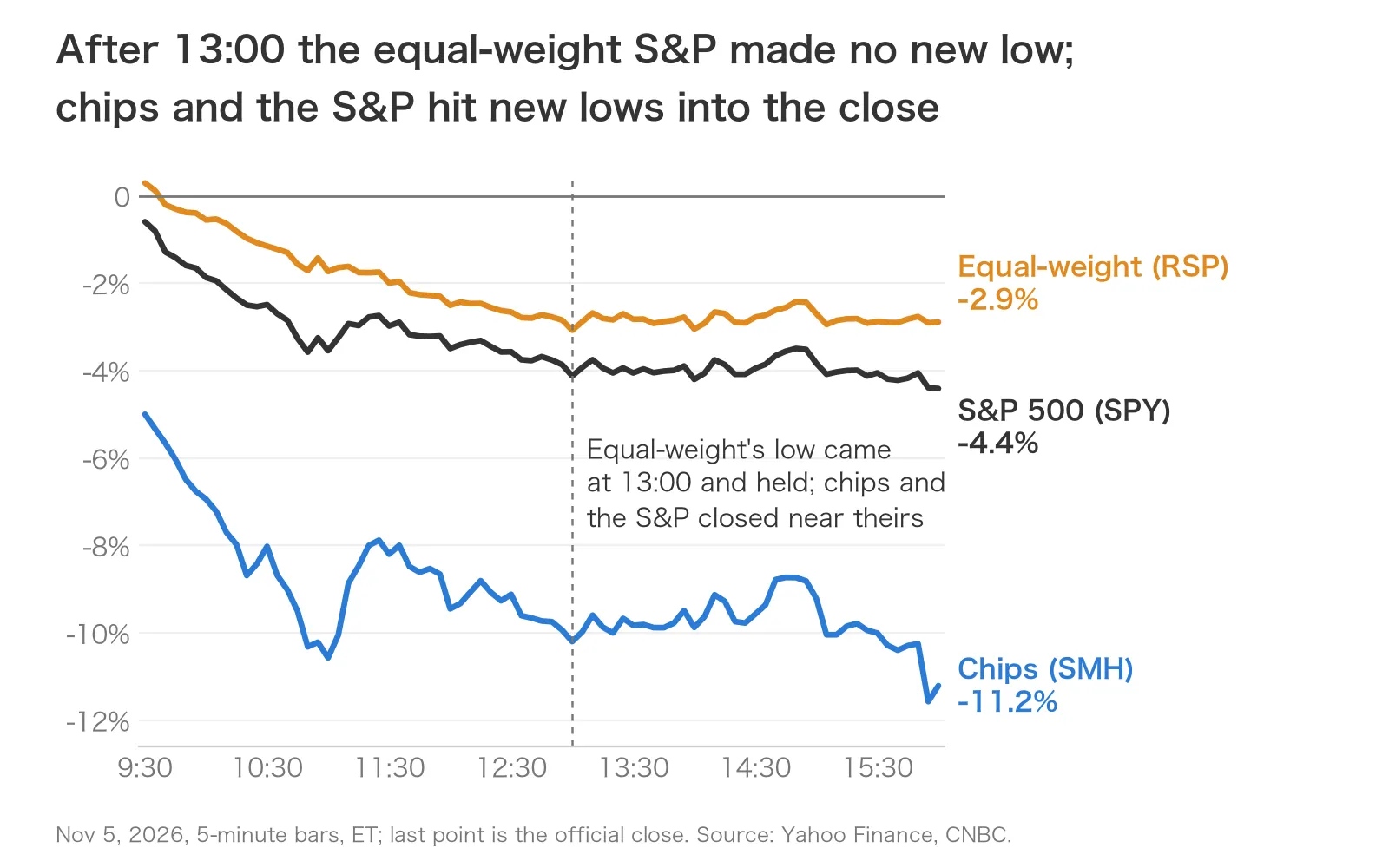
- The open: SMH opened down about 4.5%, the S&P ETF only 0.2%, and the equal-weight S&P ETF (RSP, every stock weighted the same) was up 0.3%. At this point it was still a chip problem.
- 9:57 a.m.: Reuters counted only 5 of 11 sectors lower. By the close all 11 were.
- During the session: Bloomberg reported Microsoft was tightening its review of neocloud projects (neoclouds rent out AI compute). Reuters’ summary names Nebius, IREN and Nscale.
- Around 10:50 a.m.: SMH hit the morning low, down about 11%.
- 11:00 a.m. to 1:00 p.m.: SMH bounced to down 7.9% by 11:25, then fell back to down 10.2% by 1:00. The equal-weight S&P slid from down 1.7% to down 3.1%. Chips don’t explain it all: SMH netted +0.4 points and the tech ETF was about flat, while staples, health care and energy each lost 1.7 to 1.9 points.
- 1:00 to 3:55 p.m.: SMH swung between down 8.7% and down 10.4%. The equal-weight S&P never broke its 1:00 low.
- Last 5 minutes: SMH fell another 1.3 points, at one point down 11.6%, and closed down 11.2%. The S&P made its low of the day while the equal-weight S&P barely moved. The timing fits leveraged ETF rebalancing: in an intraday note, Reuters relayed Nomura estimating that leveraged ETFs would have to sell about $47 billion before the close, the second most since the data began in July 2006, mostly from tech and AI funds. That is an estimate, not actual trades.
- After the close: chips bounced slightly after hours. In early Asian trading on Friday, KOSPI fell more than 8% and hit a circuit breaker, and the Nikkei was more than 20% below its June high.
3. Chips and the market are two questions
Why chips fell 12% and why the whole market fell 4.4% need separate answers. I multiplied SPY and tech-sector ETF (XLK) holdings by the day’s moves:
- Tech is about 60% of the fall, and chips alone are about 40% of the whole fall; everything outside tech fell about 2.5%, weighted by size. Tech here means the tech sector, so Amazon, Alphabet, Meta and Tesla count as outside tech. The ten largest names are 37.6% of the index and about 41% of the fall. Nvidia alone is 15.5% of the fall.
- No rates shock. The 10-year yield went from 4.90% to 4.84% and the 2-year from 4.58% to 4.46%. Gold rose about 0.9% and bitcoin fell 5.7%.
- Staples and utilities fell little. Staples down 0.75%, utilities 0.71%, against tech 8.0% and industrials 4.1%. Energy fell 3.0% even though Brent rose 3.8%.
4. Every plausible cause (save this)
The grouping is my judgement. Each item lists who says so, the evidence for and the evidence against.
Triggers: what got sold
- Data center limits after the vote, AI regulation (chips and the AI chain). Who says so: several big outlets, Reuters, AP, CNBC. Trump posted only “based on the results of the Election,” with no mention of data centers. For: Of 41 local measures with results by Wednesday, 40 went against data centers; UBS: about 30% of 2028 additions at risk; Goldman’s Flood: the view that by 2028 there won’t be enough land and power for data centers, leaving too many chips. Against: Texas stopped permits in September; Nomura: much of 2027 capacity is already being built, with a bigger impact from 2028; JPMorgan: no material change to 2027 capex forecasts.
- AI payback and financing (AI chain, may spill over). Who says so: several big outlets, Reuters, AP, NBC. For: CoreWeave’s five-year CDS above 1,100 bp; Microsoft tightening on neoclouds; Reuters: financing access reduced. Against: AMD CEO Lisa Su: compute demand is still intense.
- Qualcomm, Arm earnings (chips). Who says so: several big outlets, CNBC, Reuters, NBC (“triggered by two lackluster earnings reports”). For: Qualcomm handset chip sales down 26%, stock down 9.5% Thursday; Arm down 13%. Against: Qualcomm’s CEO says the problem is supply; Arm beat estimates.
Amplifiers: how hard it got sold
- A crowded AI trade unwound (chips and tech, spilling into the market). Who says so: Reuters relaying analysts; Nomura’s McElligott; Nationwide’s Hackett. For: Reuters: “an unwind of the previous session’s rally and of the crowded AI trade”; Goldman prime brokerage: big multi-strategy funds lost notably on heavy positions in AI large caps; UBS (reposted by ZeroHedge): hedge funds 23 buy to 75 sell in the morning. Against: Morgan Stanley prime brokerage data as of Oct. 29: hedge fund AI exposure had already dropped to underweight; desk notes only, no full-market data.
- Leveraged ETF rebalancing at the close (the last stretch). Who says so: one firm, Nomura, relayed by Reuters; also the X account @MgnStnlyDerivs, signed Morgan Stanley (I can’t confirm who runs it). For: Nomura estimated $47 billion of selling before the close, that account $52 billion, $21 billion of it in chips; in the last 5 minutes SMH fell 1.3 points while the equal-weight S&P barely moved. Against: Intraday estimates, not actual trades; doesn’t explain the fall before the last stretch; SMH’s close regained 0.4 points from its last 5-minute bar.
- Retail capitulation. Who says so: one firm, Vanda, quoted by Yahoo. For: Net selling of $358 million in single stocks as of 2:58 p.m., on track for the most since March 17, 2020. Against: Only through 2:58 p.m.; Vanda’s Malhi told Axios it was the most since late July; some retail was still buying leveraged ETFs such as TQQQ and SOXL.
The rest: local, backdrop or transmission
- Memory peak (local, memory stocks). Who says so: one outlet, BigGo. For: Kioxia’s weak outlook earlier in the week raised doubts on flash pricing; SanDisk down 22%. Against: Explains memory only.
- Musk exposure (local, Tesla and SpaceX). Who says so: several outlets, Yahoo, CNBC, NBC. For: Analyst Dan Ives: a harder regulatory road for a merger of the two; Tesla down 10.8%, SpaceX about 9%. Against: Tesla is about 4% of the S&P’s fall (my estimate).
- Gridlock, debt limit (weak, whole market). Who says so: one fund manager, Tuttle; CNBC. For: “two years of nothing”; CNBC calls the debt limit next year’s biggest political risk. Against: The same gridlock counted as good news on Wednesday.
- Rates, the Fed (backdrop, moved the other way that day). Who says so: Reuters, AP. For: The Fed hiked in September and traders expect another in December; AP says costly borrowing could slow data centers. Against: Yields fell Thursday; December hike odds fell to about 60%.
- Oil, Iran (backdrop, whole market). Who says so: one outlet names it, Axios (“hurt also by a rise in oil prices”). For: Brent up 3.8%; Iran says three more tankers were damaged in Hormuz. Against: Nearly 9% fall the day before; oil rose yet energy stocks fell 3%.
- Asia selling first (transmission). Who says so: commentary only. For: KOSPI down 5.28%. Against: Hang Seng up more than 3.6%; STOXX 600 down just 0.38%.
Looked for and didn’t find: tax increases, tariffs, antitrust, health-care and bank rules; export controls; bank credit stress; a named fund blowing up or getting margin calls on Thursday; and any comment on the fall from the Fed, the Treasury, Jeffries or Schumer. Walleye told investors Thursday about October’s 5.9% loss and its cuts to equity teams and return of capital; that is not a Thursday blow-up.
I checked “Democrats will limit AI” separately. Markets really are afraid of it: Reuters said the Nasdaq 100 lost $2.5 trillion because investors feared a big Democratic win would slow AI infrastructure. How much it can actually slow things is a separate question:
- How it grew. Ansari is a first-term House member. Her post said the top of the Democratic agenda on “day 1” should be a pause on advanced AI development, regulation of the industry and a ban on superintelligence. What grew was who said it. On Weibo it became “Pelosi’s top disciple says”. A Chinese finance wire relayed by the 10jqka site ran it as “US Democrats seek a superintelligence ban.” An English site made it “Democrats Plan Day One AI Ban.”
- But the direction is real. CNBC’s Thursday report: Sanders posted “National data center moratorium now,” Progressive Caucus chair Casar reposted Ansari with “Yes!”, and Senate candidates who flipped seats and re-elected Gov. Josh Shapiro named data centers in their victory speeches.
- How far leaders have gone. House Democratic leader Hakeem Jeffries said in September that AI development should slow. Asked about a superintelligence ban, Jeffries didn’t take a position, and on a data center pause at the end of June he said “That’s certainly not a position that I’ve articulated at this moment.” Lieu, in House leadership, said after the election “reasonable guardrails on AI”. Frank Pallone, in line to chair House Energy and Commerce, has said “we should have a moratorium” but hasn’t committed to pursuing one.
- Could it become law. The superintelligence ban and data center moratorium bills are in committee and lapse in January, so they must be refiled. Trump’s term runs to January 2029. An override takes 67 senators and about 290 House members, which means 11 to 13 more Republican senators and 22 to 39 House Republicans crossing over.
- What the House can do alone is hold hearings and investigate. Casar said AI company CEOs should testify under oath, and Garcia, in line to chair the House Oversight Committee, said “Lawyer up.” None of that needs the president’s signature.
- The tightening is in the states. Abbott, a Republican, paused new permits in September. Hinojosa, a Democrat, said on CNN Thursday “We need to stop what we are doing with data centers until we have measures to protect Texans.” Local votes went almost entirely one way. These limit construction and leave AI research alone. I covered the state details in the last piece.
5. My read (this part is inference)
The triggers explain what got sold, but the size of the fall needs more. Most coverage puts the data center fears and the earnings first. The fears have a basis, listed in the first item of section 4. But chips already fell 3.1% on Wednesday while the Dow rose 3%, and the same election result reached the whole market only on Thursday. I think positioning amplified real news, and I can’t say by how much.
More than one kind of seller:
- Hedge funds: Goldman’s John Flood wrote that everyone had cut positions sharply before the election, Wednesday’s move surprised traders and “sucked” them back in, and what they sold Thursday was the big tech they bought Wednesday (Reuters). Nomura’s McElligott said “They’re shooting the generals”, and Yahoo read that as hedge funds rushing to lock in their gains for the year, with no sudden change in fundamentals.
- Retail: Vanda called it “total capitulation.” Citadel Securities’ report on Wednesday said that through Nov. 3 retail had bought 22 days in a row, so the last people squeezed into this trade may have been retail.
- Leveraged ETFs: that is the closing stretch. Reuters also mentioned that some sold ahead of this selling.
- Buyers: Flood said around midday “The long only community is frozen (again)” (reposted by ZeroHedge), and Vanda said institutions were in a “buyers’ strike.” UBS, though, saw long-only funds net buying 55 to 45 in the morning. These are all mid-session accounts; nothing covers the close.
Part of the 2.5% fall outside tech is still the AI chain. Flood named engineering and construction and power stocks hit by data center limits (reposted by ZeroHedge). Industrials fell 4.1%, and Vertiv, which supplies power and cooling to data centers, fell 14%. The rest looks like ordinary risk-off: the VIX up about 70% and bitcoin down 5.7%.
The weakest part of this read is “crowded.” Morgan Stanley’s prime brokerage data as of Oct. 29 shows hedge fund AI exposure had already fallen to “Underweight,” the first time since early 2023. Citadel Securities said on Wednesday that CTA positioning was already at -3.3 standard deviations. With positions that light, selling this hard on Thursday means my explanation may be wrong.
Some don’t read it as a bust. Ed Yardeni: “I don’t think this is an AI bubble bursting,” just one losing air fast. Goldman’s economists expect Democratic governors in Texas, Georgia and Michigan to impose conditional moratoria pending new legislation, and add that since voters rank data centers low, “these moratoria will not be long-lived if they are enacted.” Still, in CNBC’s voter poll, 56% called AI and data centers a crucial or major factor.
6. What to watch: which worry comes true (save this)
These test what happens next, not what caused Thursday.
| Worry | You’d see next | Test date |
|---|---|---|
| State and local limits | Pauses written into state law; big clouds cutting 2028 capacity plans | Dec. 10 ERCOT verification report; Jan. 12 Texas Legislature convenes |
| Federal law | Jeffries or Schumer signing on to a pause bill; a committee scheduling a markup, beyond hearings; 11 to 13 Republican senators cosponsoring; a pause attached to a must-pass bill such as defense; a major AI safety incident (Evercore’s caveat) | Jan. 3 new Congress |
| AI payback and financing | Big clouds cutting capex; CoreWeave’s CDS still widening; stocks outside tech recovering while chips don’t | Nov. 17 Nvidia earnings after the close, so Nov. 18 for the market’s verdict |
| Only positioning | The next desk notes show hedge funds buying chips back, long-only funds starting to buy, and retail buying the dip again | The next few sessions |
| Rates | Stocks falling while yields rise, the opposite of Thursday | Nov. 6, 8:30 a.m. ET payrolls; Dec. 9 Fed decision |
| Oil | The market falling as oil keeps rising | News from Hormuz and the Iran war |
A prompt to paste into an AI
Use an AI that can browse, such as Claude Code or Codex. On the next big down day, fill in the date:
Attribute a big market fall for me. You must browse: open the original reports, don't rely on search snippets or memory. Give every fact a link and a time. If you can't find something, write "not found". Attribution only, no buy or sell advice. If the market hasn't closed, state the cutoff time of your numbers; after the close, recalculate everything and recheck each intraday conclusion one by one.

Date: ______
Worst-hit sector: ______ (e.g. semiconductors)
Market index: ______ (e.g. S&P 500)

1. Size it: how far the index and the sector fell that day, how often a fall that size happens, and when it last did.
2. Split it: why the sector fell, and why the market fell. Multiply constituent weights by the day's moves to get the share of the index's fall from the top ten names, from this sector and from everything else, and how far everything else fell, weighted by size.
3. Trace the spread: pull 5-minute bars for the sector ETF, a cap-weighted ETF (SPY), an equal-weight ETF (RSP) and defensives (XLP, XLU, XLV). Who fell first, which stretch was steepest, and did the market move with the sector's bounces and drops? Look at the last 30 minutes separately and check them against the official closing prices.
4. Check other assets: 2-year and 10-year Treasury yields, the dollar, gold, oil, VIX, bitcoin. Does it look like a rates shock, a growth scare, or selling risk?
5. List every candidate cause: policy, earnings, sector fundamentals, financing and credit, positioning and leverage, rates, geopolitics, overseas markets. For each: the mechanism in one line, who says so (outlet, time, link, exact words), evidence for, evidence against. Grade by source: several big outlets / one outlet or a named strategist / commentary only / looked for and not found. Then mark its role: trigger, amplifier, local, backdrop.
6. Any flow claim (hedge fund deleveraging, retail, leveraged ETFs, CTAs) needs a named firm or data; for a desk note, say whose it is and who reposted it, and separate estimates from actual trades. Otherwise mark it "no data".
7. Timeline: list events in ET, noting that sequence isn't cause.
8. End with your read (labelled as inference), the strongest counterargument, what each worry would look like if it comes true, the date that tests it, and what evidence would prove you wrong.
How I checked
Closing prices come from CNBC, FMP and Nasdaq, 5-minute bars from Yahoo, weights from SSGA’s SPY and XLK holdings, and Treasury yields from the US Treasury. I counted the S&P history twice, with separately written code on FMP and Yahoo data, and the counts match. I can’t read paywalled Bloomberg, FT or MarketWatch stories, so the Bloomberg item comes through Reuters’ summary. The UBS note and some of Flood’s exact words appear only in ZeroHedge reposts.
I wrote a first version of this during the session, and two conclusions flipped after the close. “Chips bottomed in the morning” was broken by the last 5 minutes, and “energy held up” became energy down 3%. It’s best to settle the attribution of a big down day after the close.
For how stocks usually behave after midterms, see this piece.
The part I’m least sure of is who sold: how much was hedge funds, retail and leveraged ETFs. Right now there are only desk notes and pre-close estimates. If you have full-market flow data, post it in the replies and I’ll change it. Do you think Thursday was mostly news or mostly positioning? Tell me that too.