AI stocks fell after the midterms. Will data centers really stop getting built? I checked
Will the midterms stop US data center building? In 6 of 8 states both governor candidates want limits, and Texas paused before the vote. Table, dates, prompt.
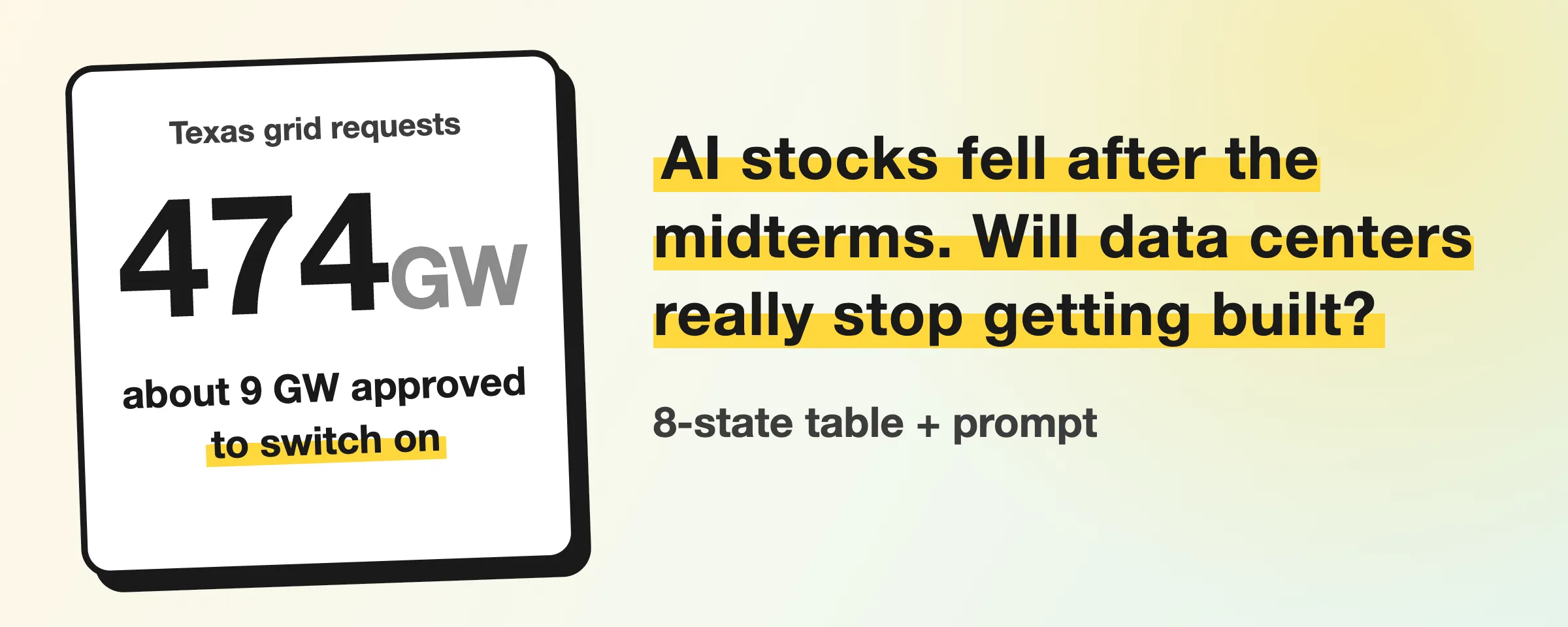
AI stocks fell on election night on fears that data centers won’t get built. I checked: the restrictions are real, but Texas paused before the vote, and in 6 of the 8 states I looked at, both candidates want to tighten.
Democrats won both chambers of Congress (NBC projection). Texas also elected Gina Hinojosa governor. She wants an immediate data center moratorium, and Wells Fargo estimates Texas holds about 27% of US data center gigawatts. Stock futures flipped from up to down: S&P 500 futures fell 1.3%, Nasdaq-100 futures 2.2%, CoreWeave 6% in overnight trading, and Japan’s Nikkei about 4.5%.
What I found:
- Texas was already paused. Gov. Greg Abbott, a Republican, ordered an audit on August 3. The grid operator then stopped approving large data centers to switch on, and environmental permits stopped in September. The open question is how long it lasts under a new governor.
- Most of the 474 GW requested hasn’t finished the process. That’s five times the grid’s record peak, and about 9 GW is approved to switch on. The next marker is the December 10 verification report.
- Most of these states tighten whichever party wins. In 6 of the 8, both candidates want limits: 4 on permits, 2 on tax breaks. The power sits mostly with states, and Goldman sees a national moratorium as unlikely.
- Tai Hui of J.P. Morgan Asset Management doubts the election is the main cause. “How much is really the election, how much is the AI story that’s fermented since three or four weeks ago?” His answer: “I think it’s the latter rather than the political story.”
- Watch the next close. After the last 19 midterms, the S&P 500 fell more than 0.8% the next day only twice, and rose 15 times.
Below: a Texas table by project stage, the 8-state table, the dates to watch, and a prompt that checks which states your holdings touch.
1. Where the results stand (about 11:40 p.m. ET, Nov. 3, still moving)
- House: Democrats won it. NBC estimates about 255 seats; 218 is a majority.
- Senate: NBC projects Democrats won it, at 51 seats so far, a net gain of 6 (Iowa, Kansas, North Carolina, Ohio, South Carolina, Texas).
- Governors: Hinojosa in Texas (AP and CBS projections; Abbott conceded), Amy Acton in Ohio, Keisha Lance Bottoms in Georgia and Josh Shapiro in Pennsylvania won. Michigan and Arizona are uncalled.
2. Texas: what a new governor changes
Scott Ladner of Horizon Investments said that night that for the next couple of days the AI trade “does hinge on does Abbott win or not.” Abbott lost, but the pause isn’t new.
On August 3 Abbott ordered an audit of data center projects seeking grid connections, and ERCOT, the Texas grid operator, stopped approving data centers of 75 MW or more to switch on. On September 21 environmental permits stopped too, until the audit ends. ERCOT aims to file its verification report on December 10. Abbott will still be in office then; the new governor starts in January.
Evercore, citing another bank’s analysis, wrote that “Abbott is likely to lift the Data Center Moratorium whereas Hinojosa is expected to maintain it.” Her campaign position is a moratorium until the legislature acts. A governor can direct state agencies by executive order. Laws need the legislature, and pre-election reporting expected Republicans to keep both chambers.
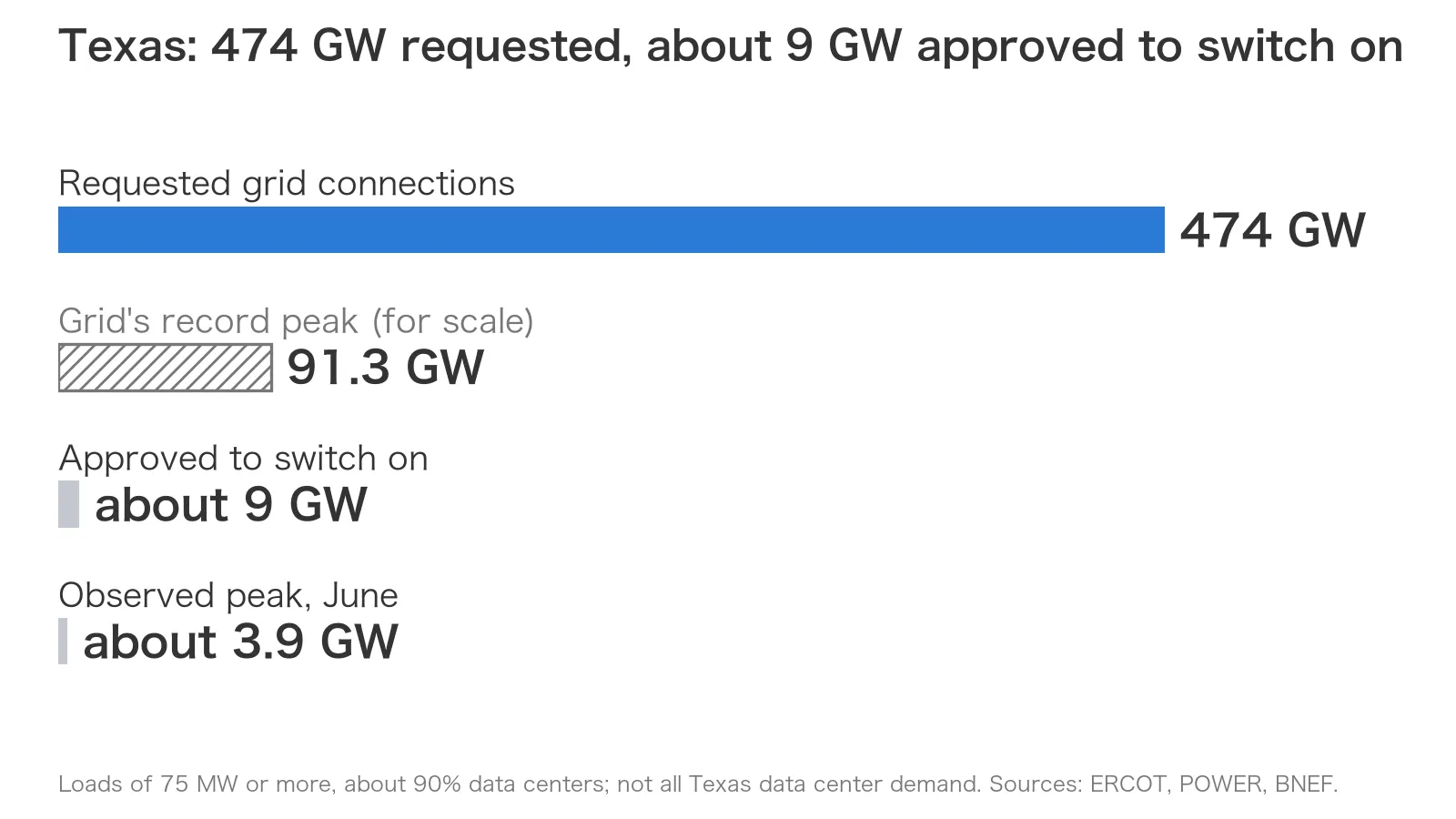
Find where your holding’s projects sit:
| Where a project stands | Size | What the pause does |
|---|---|---|
| Requested, still in the queue | 474 GW, about 90% data centers | Studies paused until the audit |
| Finished everything but approval to switch on | 17 large loads, 6.6 GW | Stuck: approvals paused |
| Approved to switch on | About 9 GW (June) | Approved before the pause |
| Already drawing power | About 3.9 GW observed peak (June) | Approved before the pause |
These rows use different bases, so don’t add them. They count only large loads of 75 MW or more, not every data center in Texas.
BloombergNEF estimates the pause could delay 49.8 GW, almost 20% of the 253 GW US pipeline. By the first quarter of 2027 those projects could lose about $8 billion cumulatively if 60% of the capacity is AI, and up to about $15 billion.
Not everyone in the industry objects. Operator QTS welcomed Abbott’s move and said its existing commitments predate the audit. Power seller Vistra said in August it doesn’t expect the pause to touch its 1.2 GW deal with Amazon. CEO Jim Burke: “I’d like to see the queues culled, at the end of the day.”
3. The 8-state table (worth saving)
I picked eight states electing a governor this year where data centers were a campaign issue. Virginia is also a major hub, but it isn’t electing a governor this year.
| State | Democrat | Republican | Tighter either way? | Result |
|---|---|---|---|---|
| Texas | Hinojosa: immediate moratorium until the legislature acts; stop subsidies | Abbott: permits already halted pending the audit; also wants to end the tax break | Yes | Hinojosa won |
| Ohio | Acton: conditional moratorium, developers cover utility costs | Ramaswamy: halt new state approvals on day one until legislation passes | Yes | Acton won |
| Michigan | Benson: moratorium until guardrails are in place | James: no new data centers until there’s a plan to protect residents | Yes | Uncalled |
| Oregon | Kotek: already paused state-land requests and environmental permits, to July 2027 | Drazan: immediate statewide moratorium | Yes | Uncalled |
| Arizona | Hobbs: rejects a statewide moratorium; signed a 3-year pause on new tax breaks | Biggs: rejects a moratorium; wants the tax breaks gone for good | Yes (tax) | Uncalled |
| Illinois | Pritzker: already paused new tax-break applications | Bailey: would pause all existing tax agreements | Yes (tax) | Uncalled |
| Georgia | Bottoms: temporary moratorium | Jackson: opposes one, leave it to local communities | No | Bottoms won |
| Pennsylvania | Shapiro: hasn’t backed a moratorium | Garrity: a pause for zoning updates, nothing of three years or more | No | Shapiro won |
Data Center Watch looked at 74 candidates in 36 governor races: 43% back a ban or moratorium, 58% of Democrats and 30% of Republicans. The party gap is real, yet 24 of the 36 races have at least one candidate in favor.
Voters are also deciding directly. On November 3, Trenton, Ohio, voted to ban large data centers, 80% in favor with all precincts in. Urbana banned them too, 77% in favor (both unofficial).
Who holds which tools:
- Governors and legislatures: environmental permits, state land, tax breaks. New York paused environmental permits for projects of 50 MW or more in July, for up to a year. Arizona paused new tax breaks for 3 years.
- Federal agencies: federal land and transmission rules. In June, FERC told six grid operators to reassess their large-load rules.
- Congress: tax breaks and budgets. Goldman says it might limit data center tax incentives. Even with both chambers there’s a presidential veto, and CNBC expects gridlock, with necessary funding bills possibly the only ones to pass.
Many candidates tie the limits to power bills. In May the Energy Information Administration forecast residential power at 18.2 cents per kWh this year, up nearly 5%, citing fuel prices, grid hardening and rising demand. How much data centers contribute remains disputed.
4. Dates to watch (worth saving)
| When | What | Why it matters |
|---|---|---|
| December 10 and 17 | ERCOT aims to file its verification report; Texas utility commission meets | How much of the 474 GW counts, and whether the pause loosens |
| January 3, 2027 | New Congress sworn in | House investigative and budget power starts |
| January 2027 | New Texas governor takes office; legislature convenes on the 12th | Whether the pause gets written into law |
| During 2027 | Debt ceiling | Tai Hui flags it for next year, and the president keeps his veto |
| July 2027 | New York’s pause ends at the latest; Oregon’s also ends | Extended or lifted, other states will look at it |
5. How big is a big next-day move?
From the data in my last piece, the S&P 500 on the day after a midterm:
| Case | Times | Average next day | Times up |
|---|---|---|---|
| All midterms | 19 | +0.6% | 15 |
| House changed hands | 6 | +0.4% | 4 |
The two falls beyond 0.8% came in 1990 (−1.8%) and 2022 (−2.1%). A year later the index was up 25.1% and 14.5%, which is too small a sample to mean much. JPMorgan’s trading desk estimated before the vote that a blue wave would knock the S&P about 0.5% the next day, and futures fell more than that on election night. This year’s number, the 20th, comes with the November 4 close.
A prompt to paste into AI
Use an AI that can browse and read files, such as Claude Code or Codex. It checks exposure and gives no trade advice:
Check my portfolio's exposure to US data center restrictions. You must browse and open the original documents. Don't rely on search snippets or memory. Attach a link to every fact, write "not found" when you can't find something, and say so if a document was cut off before you finished reading it.

My holdings: ______ (for example CRWV, ORCL, VST)

State policies: ______ (paste the table from section 3 of this article. For states not in it, check whether they currently pause approvals or tax breaks.)

For each company:
1. Open the latest 10-K or 10-Q (SEC EDGAR) and the latest earnings release. Find which states hold its US data centers. If the company doesn't disclose this, third-party data is fine, but name the source.
2. Check by business type:
   - Builds or rents compute: the states of its sites, operating, under construction and still queued listed separately, with megawatts where available.
   - Sells power: its contracts with data centers and the states of the plants behind them.
   - Sells equipment: its largest customers and the states of their sites.
3. Calculate the share of capacity in states marked "Yes" only if the numerator and denominator come from the same disclosure, and state the denominator. Otherwise list the states and known capacity, and don't estimate a share.

End with one table: company, business type, states involved, policy status, known capacity, source links. No buy, sell or price-target advice.
I ran this twice on CRWV, ORCL and VST, which is how I found the Vistra contract above. The parts of the CoreWeave and Oracle filings I could read didn’t name states, so those rest on third-party data, and the capacity share couldn’t be calculated.
How I checked
Candidate positions come from Data Center Watch, Newsweek, WNEM, OPB, ABC15 and campaign pages. Results come from NBC and CBS. The next-day moves run from the election-day close to the next close.
“Six states tighten whoever wins” is my own count, and it lumps paused permits with tighter tax breaks; on permits alone it’s 4. If you know a state’s position better, or someone changes their tune after the vote, tell me in the replies and I’ll fix it.