Google is spending $200B on AI this year, $200 per Gemini user: 7 things that affect you (plus a prompt)
Google will spend $200B on AI this year, more next year. 7 things from the call that reach users: tight capacity, ads in AI answers, TPU sales. Plus a prompt.
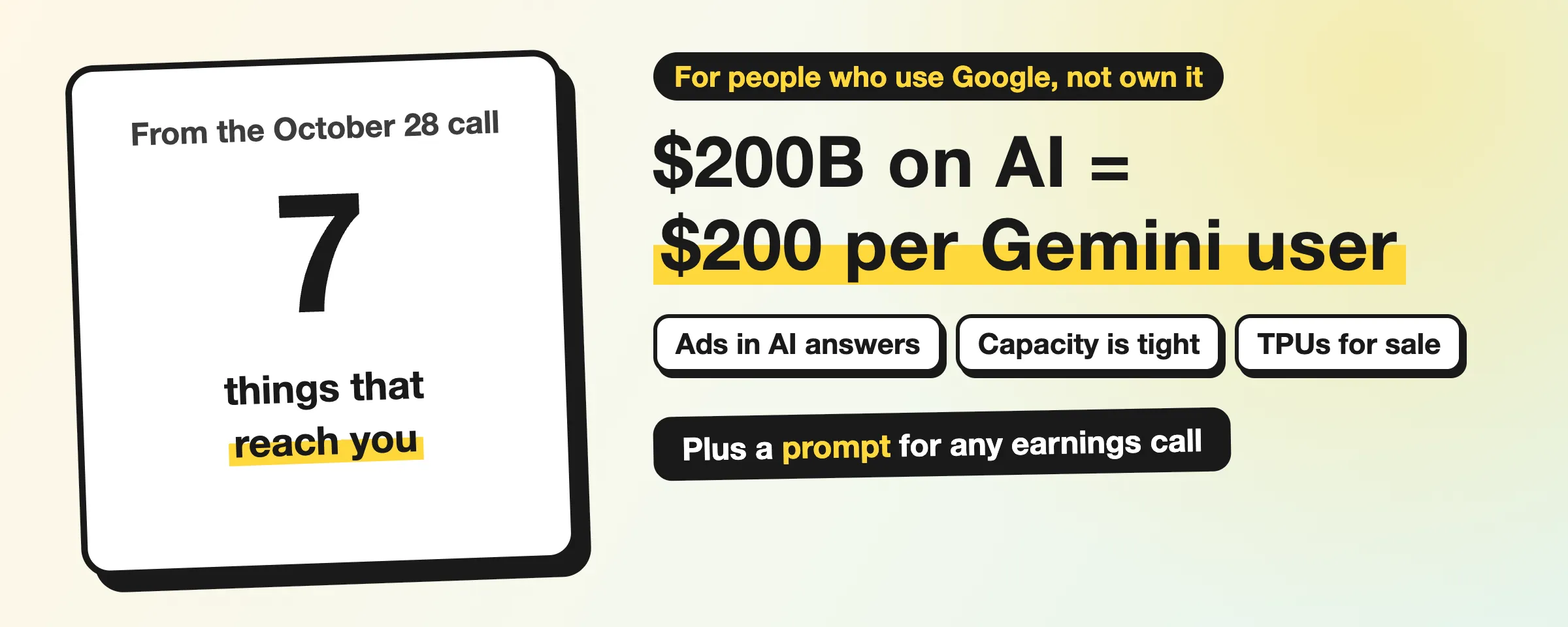
Alphabet, Google’s parent, will spend $195B to $205B this year on chips and data centers, and significantly more next year. That is 40% of its annual revenue. The Gemini app has reached 1 billion users. Divide $200B by that and Google is spending $200 on data centers for every Gemini user this year (rough math: the same data centers also serve Search, Cloud and YouTube).
The stock fell 10% after hours. That is the shareholders’ problem, and I covered it in the previous piece. This one is for people who don’t own Google stock but search on Google, watch YouTube or use Gemini every day, or buy ads on Google. I read the whole transcript of the October 28 earnings call and picked out 7 things that affect you directly.
At the end there is a list of changes you will see in Google products over the next few months, and a prompt: hand AI any company’s earnings call transcript and it will pick out the parts that affect you and explain them.
1. Usage is growing faster than the data centers
On the call, Pichai gave two numbers: the Gemini app has 1 billion users, and Google’s APIs process 32 billion tokens a minute, more than four times what they did a year ago. “We are working hard to bring more capacity online to meet this long-term demand.”
Constraints came up more than once. Usage on the developer platform grew “even with capacity constraints,” and the CFO described the cloud business as working in a “supply-constrained environment.” In plain words, more people want to use it than the machines can serve. Developers waiting in line for the API and cloud customers waiting for machines both come back to this.
The $200B goes to closing that gap. It shows up in the Gemini you use a year or two from now, not this year.
The CFO also said a new batch of third-party computing power came online at the end of Q3, meaning computing power Google pays other companies for. “We expect margin headwinds in the near term as we utilize this capacity.” She was talking about cloud margins: how much of its revenue Google keeps as profit.
Once the capacity is in hand, what the company wants most is to fill it. AI prices kept falling over the past two years, and I think this is the supply-side reason.
2. More ads in AI answers
When you search a question on Google, the AI-written answer at the top will carry ads more and more often, outside the US too. If you buy ads for a small business, the slots in AI answers are new. Their price and results are not settled yet, and the people who get in early are buying cheap traffic.
Google is adding them because of the numbers that mattered most on the call. They are also one of the main reasons the stock fell 10%.
Search ad revenue was $63.4B, up 12%. The two quarters before grew 19% and 17%. Pichai said AI Mode queries (AI Mode is the chat-style way to search on Google) are on average three times longer than traditional searches, and search query growth is the highest it has been in five years. More people are searching and asking longer questions, but ad revenue growth is falling.
Google’s ads chief gave two reasons. The biggest reason for the slowdown from last quarter was exchange rates. The other he stated plainly: searches in AI Mode earn less from ads than traditional search does.
Google announced its answer the same day. Ads in AI search, meaning the ads in AI Overviews and AI Mode, roll out from the US to every market where AI Mode runs. In his words, this means “taking our monetization footprint global for the first time.” Monetization means turning users into revenue.
3. Google sells whole TPU systems to others, reportedly including OpenAI
Today most AI companies train their models on Nvidia chips. Google designs its own AI chip, the TPU. Customers who wanted it used to have only one option, renting computing power on Google Cloud. The chips never left Google’s data centers.
That changed this year: Google now sells complete TPU systems, installed in the customer’s own data center or a third party’s. This quarter’s 8-K, the earnings filing Alphabet sends to the SEC, calls TPU system sales “a meaningful contributor to revenue growth” for the first time. They are also in the backlog of signed orders not yet delivered. The CFO described what Google sells as “not just a chip, but it is a specialized system.” She said these sales keep scaling in Q4, followed by “a meaningful revenue ramp in 2027.”
One more supplier selling complete systems gives AI companies another lever when they bargain over cost, and that cost ends up in the price of every AI product you use.
The day before, reports said OpenAI plans to buy Google’s TPUs. Both companies declined to comment. If it happens, OpenAI’s models run on Google’s chips and the two companies are rivals and customers at the same time, so take the next “Google vs OpenAI” headline with a grain of salt.
4. Cloud doubled: the part of the $200B that is already paying off
Google Cloud revenue was $30.7B, double a year ago, with $11.1B in profit. Signed contracts not yet delivered total $561B, and more than half of that turns into revenue within two years.
Some of these data centers run Google’s own Gemini and search. The rest are rented to other companies to run AI. The rented part is already making money, and more than expected. Analyst Dan Ives called it the cloud report card he had been waiting a long time for.
If you run a small business or build a product, you have more AI computing power and AI models to rent. Google, Microsoft and Amazon together are investing in data centers this year at a scale never seen before, and once those data centers are built they need tenants.
5. Who gets the money
Where the $200B ends up is not broken out on the call or in the earnings release. The three categories below are my own, from general industry knowledge:
- Chips. Google designs the TPU and contract manufacturers make it. Google also buys Nvidia GPUs. The CFO made a point of saying Google is building up TPU inventory, which went from $2.4B to $13.3B in a year. That money sits on the shelf and weighs on cash flow.
- Servers and memory. Memory is a big part of an AI server’s cost, so memory makers’ orders and prices this year have moved with this spending.
- Data centers, land and power. Each one needs a site, a building and a power line. A large AI data center uses as much electricity as tens of thousands to more than a hundred thousand homes. That is one reason electricity prices and power companies have been in the news more these past few years.
The same day, Microsoft reported its capital spending for the quarter, the money that goes to land, buildings and equipment: $45.2B including leases ($39.4B in cash). That is the same order of magnitude as Google’s $51.4B for the quarter.
6. Waymo: 300 million miles, still burning cash
Robotaxis are coming to more cities. Pichai said Waymo has driven more than 300 million fully autonomous miles and is expanding overseas.
Other Bets, the segment it sits in, had $372M in revenue this quarter and lost $2.0B. Google will keep going, paid for by what search and cloud earn. Waymo does not need to make money any time soon, and that is the biggest difference between it and the independent self-driving companies.
7. Where the money comes from: Google has started raising money like a startup
This last one has little to do with users, but it shows how much Google is willing to pay for the six above.
Alphabet used to spend over $10B a quarter buying back its own stock. This year buybacks are zero. Instead, this quarter it sold $12.4B in new shares and issued $28.7B in bonds. A few years ago it carried only $10B to $20B of debt. In one year it borrowed $100B and started selling stock.
What you will see in Google products over the next few months (bookmark this)
| What you’ll see | Why | What the call said |
|---|---|---|
| Ads in the AI answers on Google Search, in every market where AI Mode runs | Search ad growth fell to 12% and Google wants it back | “taking our monetization footprint global for the first time” |
| Gemini API and Google Cloud machines still short on capacity | Usage is up 4x and the data centers are still being built | “capacity constraints”, “supply-constrained”, “bring more capacity online” |
| Complete Google TPU systems for sale, besides Nvidia chips | Complete TPU systems sold to others, revenue ramping in 2027 | “not just a chip, but it is a specialized system” |
| More AI computing power to rent | New third-party computing power came online at the end of Q3, and $561B in orders has to be delivered | “margin headwinds in the near term as we utilize this capacity” |
| Robotaxis in more cities | Waymo is expanding overseas, funded by its parent | 300 million miles, Other Bets lost $2.0B |
Prompt to paste into your AI
Find the transcript of a company’s latest earnings call (Investing.com, Motley Fool and the company’s investor relations page all have them). Copy the full text into a text file, put it in an empty folder, open Claude Code or Codex in that folder and paste this:
Read the transcript of a company's earnings call and explain it to an ordinary person who doesn't own the stock but uses its products every day. The file is in the current folder.
1. List every number management gave that relates to users: user counts, usage, prices, new products, products being shut down. Quote the exact sentence from the transcript for each.
2. Find where the company says it will spend money (capital spending, hiring, acquisitions) and how much. In one sentence each, say what that money will turn into that users can see, and when they will see it.
3. Find the businesses where the company says it earned less or growth slowed. Explain how the company plans to make up for it and what that means for users (more ads, higher prices, smaller free allowances, or something else).
4. Find anything the company is doing, or admitting, for the first time.
5. In the analyst Q&A, list the questions management dodged or didn't answer directly.
6. Finish with a three-column table: changes users will see in the next few months / why / the exact words from the call.
Where the transcript doesn't say, write "not stated". Don't guess on the company's behalf.
Swap in another company’s transcript and it works the same way.
Two more pieces on the same earnings: what the 8-K actually says, and how big tech stocks moved after past earnings-day drops.
How I read it
- Numbers and quotes come from Alphabet’s October 28, 2026 earnings call transcript and 8-K Exhibit 99.1.
- “$200 per Gemini user” is my own rough math: $200B in capital spending divided by 1 billion Gemini users. The same money also serves search, cloud and YouTube, so the number only shows the scale. It is not a split the company published.
- OpenAI buying TPUs comes from reporting by Bloomberg and The Information. Both companies declined to comment.
- The categories in section 5 and the data center power comparison are my own grouping from general industry knowledge. The company does not break down where its capital spending goes.
- This is a write-up of the earnings call and not investment advice. If I got something wrong, tell me in the comments and I’ll fix it.
Sources:
- Q3 earnings call transcript (Investing.com)
- Alphabet Q3 2026 8-K Exhibit 99.1
- TechCrunch: Google takes AI search ads global
- Bloomberg: OpenAI plans to buy Google’s chips
- CNBC: Waymo expands overseas and is still a small, cash-burning business
- CNBC: Microsoft’s earnings the same day
- Fortune: analysts on the Cloud result
Which of the changes in the table have you already run into in a product you use? Has the AI answer at the top of your Google search started showing ads where you live?