The S&P 500 fell 8.6% in a week. Did Washington and Wall Street rig it? I traced who did what
Why US stocks fell 8.6% in the week to Nov 20. My read: the Fed, regulators, short sellers and Anthropic's IPO pushed AI the same way, with no sign of a plot.
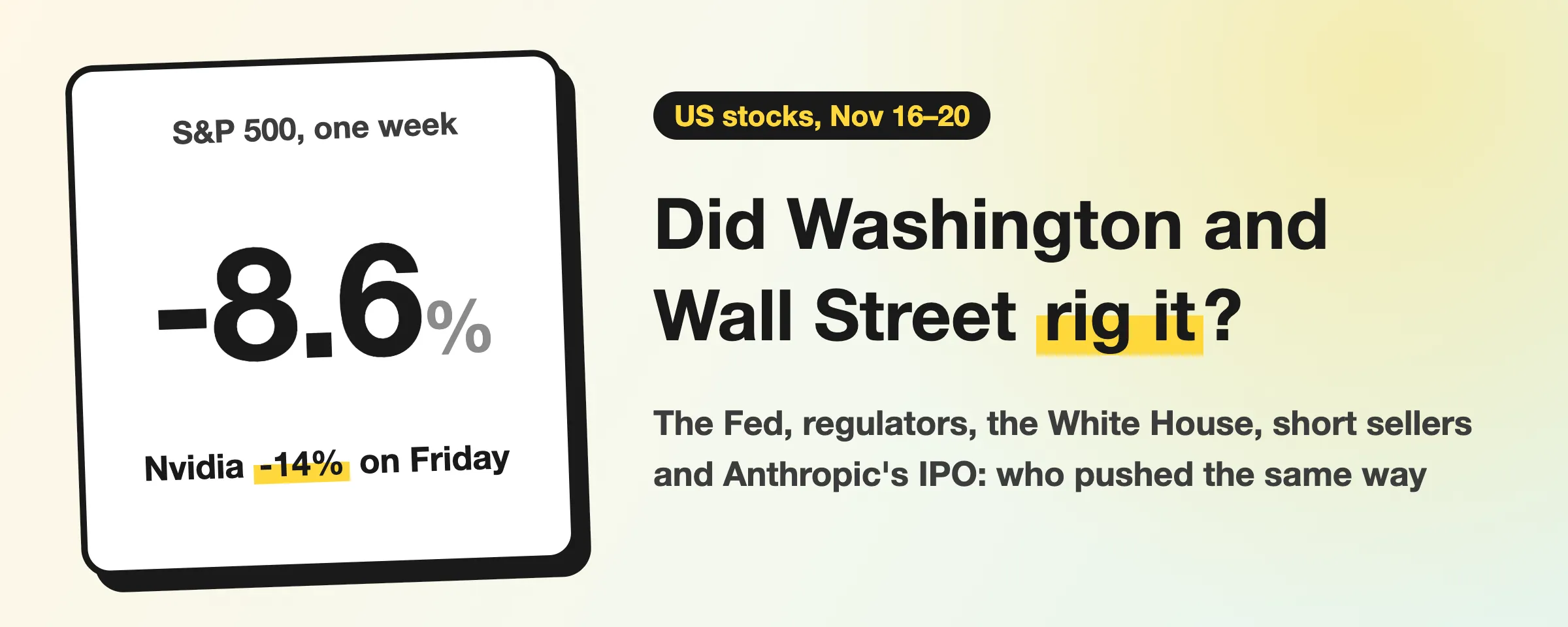
From Monday Nov 16 to Friday Nov 20 the S&P 500 fell 8.6%, its 12th-worst week since 1950 and the worst since the April 2025 tariff week. Friday alone took 3.7% off the index, 5.3% off the Nasdaq and 14% off Nvidia. The S&P now sits 11.6% below its Oct 6 high, in correction.
A drop like that raises the question: did Washington and Wall Street rig it? I lined up what every player did this week, when, and what they said, then checked Friday’s two legs down against the headlines on 5-minute bars. What I found:
- My read: most likely several players moved the same way at the moment of Anthropic’s blockbuster IPO, to keep the AI bubble from inflating further. I found no one coordinating it, and most of the moves landed in the days around Anthropic’s Wednesday-night pricing.
- Washington’s side: Fed Governor Barr called out $800B of AI company debt, Waller said a 50bp hike is “probably necessary”, and Goolsbee said the AI boom risks overheating the economy. The SEC, Congress and California’s attorney general all went after Nvidia.
- Wall Street’s side: short sellers took aim at Nvidia and AMD, and analysts kept supplying reasons to sell AI chips. Anthropic rose 17% on day one and was back at its IPO price intraday the next day; CNBC wrote that the debut fed fears of “a collective cash-out moment for the AI complex”.
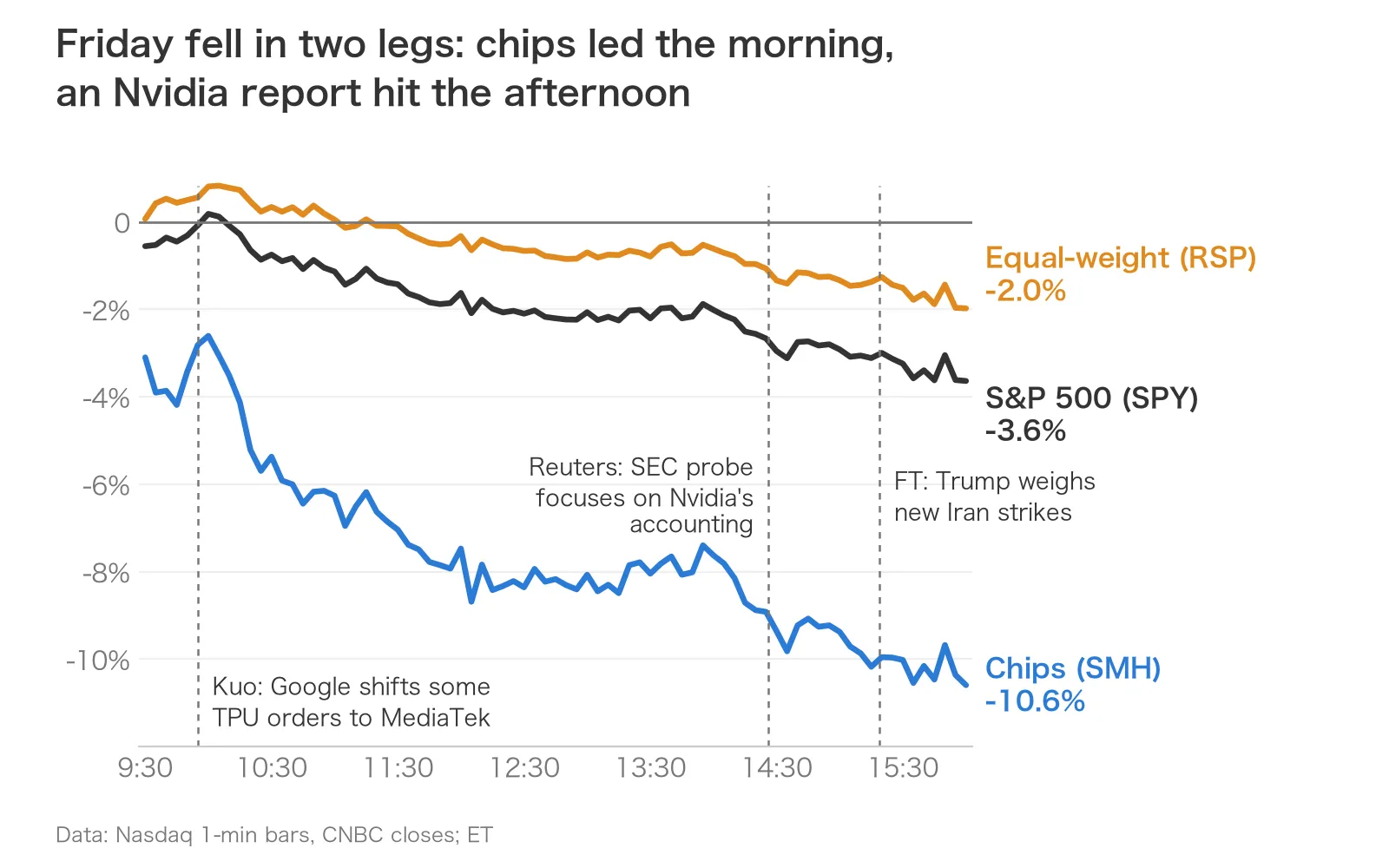
- Friday’s 3.7%: two legs, each lined up with one headline. Just after the open, Ming-Chi Kuo posted that Google is moving part of its TPU orders from Broadcom to MediaTek, and Broadcom closed down 12%. In the afternoon, Reuters reported the SEC probe is focused on Nvidia’s accounting, and Nvidia closed down 14%. By my estimate Nvidia alone was about a fifth of the S&P’s drop, tech about 70%.
- Where the money went: gold futures fell about 9.5%, bitcoin about 15%, copper about 10%. Treasuries and the yen rose; the 2-year yield fell a quarter point. Stocks outside tech fell 6.7% cap-weighted. It looks like everything sellable got sold and the cash went into bonds.
Below, in order: what each player did, my read, the numbers, the timeline, every candidate cause, what to watch next (worth bookmarking), and a prompt that has an AI line up every player’s moves for the next selloff. All figures are Friday closes.
1. Who pushed the same way
Each group had its own reasons, but all of them cooled AI, and most of the moves landed in the days around Anthropic’s Wednesday-night pricing.
- The Fed, naming AI most directly: Monday, Barr on $800B of on-balance-sheet AI debt and off-balance-sheet liabilities that could exceed $3T; Wednesday, minutes saying nearly everyone expects more hikes, and Waller floating 50bp; Thursday, Goolsbee on AI-driven overheating; Friday, Cook warning that waiting longer on hikes risks falling behind the curve.
- Regulators and Congress, on Nvidia: Tuesday, the SEC probe and California’s “red flags” hit the press; Thursday, the House Foreign Affairs Committee’s China license data and California’s subpoena; Friday, Reuters on the SEC’s accounting focus. Their reasons are disclosure, China exports and Huang’s scandal.
- The White House, mostly on Nvidia: Sunday (Nov 15), Treasury Secretary Bessent said Nvidia needs a shake-up and an outside CEO; Monday, Commerce closed the loophole for Chinese firms renting Nvidia compute abroad; Friday, Trump threatened a heavy tax on US firms building AI data centers abroad. Commerce and Bessent cited China; Trump gave no reason for the tax, and this week said he wouldn’t mind Huang coming back.
- Short sellers and analysts, supplying the bear case: Nov 13, SemiAnalysis cut its 2030 AI chip spending forecast by 40%; Tuesday, Muddy Waters shorted Nvidia; Thursday, Hunterbrook shorted AMD; Friday, Kuo said Google is moving TPU orders to MediaTek.
- Anthropic’s IPO, up and back down: valued at about $1.5T, it raised about $81B, one of the largest IPOs ever; it opened at $111.50 on Thursday and was back at its $83 offer price intraday Friday.
2. My read: same direction, no sign of coordination
This section is inference.
Most likely same-direction moves, not a plot. The five groups above acted in the same week and in the same direction. I found no evidence that any of them coordinated with another, and they didn’t need to: with AI valuations and debt this large, central bankers, regulators, short sellers and existing holders are looking at the same thing, so acting at about the same time isn’t strange.
“Keeping the bubble from growing” is my inference from the outcome. Fed officials named AI most directly: Barr on AI firms’ debt, Goolsbee on AI-driven overheating. The others gave their own reasons: regulators cited disclosure and China exports, short sellers China risk and circular deals.
Why this week. Anthropic, valued at about $1.5T, raised about $81B, one of the largest IPOs ever and the most-watched deal of this AI cycle. For anyone worried about a bubble, that’s the moment to throw cold water on it; for anyone holding AI stocks, it’s when buyers are most plentiful. None of the players said so.
Nvidia was the easiest place to push. A CEO gone, a board refusing his return while Trump says he’d welcome it, regulators at the door: strong results couldn’t hold the stock. When the leader breaks, the whole AI chain gets repriced.
The Fed’s push didn’t come through rates either. Yields fell every day this week; what it hit was expectations for AI.
The market was already fragile. The S&P had just lost 4.4% on Nov 5, the 10-year hit 5.15% the week before, a December hike was all but certain, and worries about AI financing never went away.
My weakest point: stocks outside tech also fell 6.7%, and not all of that is AI; softer data, hike expectations and possibly mechanical selling after the VIX rose 86% may account for part of it. There’s no market-wide data on who sold how much, and no hard numbers this week for CTAs, options expiration or leveraged ETFs.
What would prove me wrong:
- The Fed doesn’t hike in December, or stops mentioning AI: that push was weaker than I think.
- The Nvidia probes fizzle and AI stocks keep falling: fundamentals are changing, not outside pressure.
- Big tech cuts AI capex: the bubble is deflating on its own, not being pushed down.
- Evidence of coordination turns up: then it’s more than same-direction.
3. The numbers: Friday was Nvidia, the week was everything
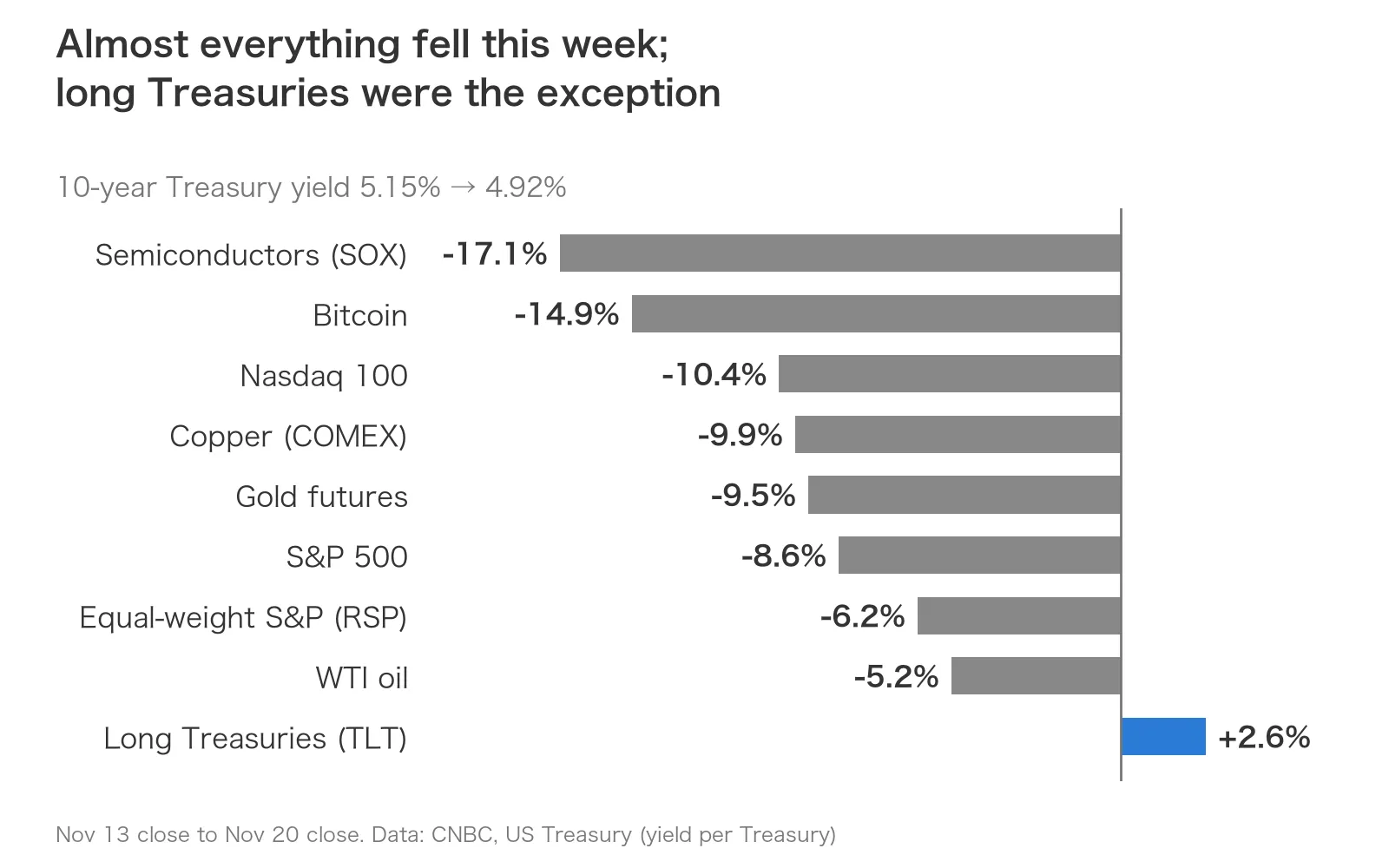
- The week: the Nasdaq Composite fell 10.0%, the Nasdaq 100 10.4%, the Dow 8.0%, the Russell 2000 7.5%, the Philadelphia Semiconductor Index 17.1%.
- Friday: -3.70%. Only 71 days since 1950 fell that far. The previous one was Nov 5, eleven trading days earlier.
- Every day down: Monday -1.92%, Tuesday -1.03%, Wednesday -0.23%, Thursday -2.02%, Friday -3.70%. Friday alone was about 40% of the week.
- Nowhere to hide: 31 of the 500-odd S&P names rose on the week. On Friday only consumer staples gained (+0.67%). The VIX went from 19.3 to 35.9, up 86%.
I multiplied SPY’s holdings weights by each stock’s move to estimate who did the damage:
- Friday was a tech day: tech contributed about 68% of the S&P’s drop, semis about 48%, Nvidia alone 22%. Everything outside tech fell only 1.8% cap-weighted, and staples rose. The equal-weight S&P fell 1.98%, about half the index’s drop.
- The week was broad: tech was only half the drop. Everything outside tech fell 6.7% cap-weighted, the equal-weight S&P fell 6.2%, all 11 sectors fell, and industrials, communication services, financials and materials each lost more than 7%.
- Not a rates shock: the 2-year yield fell from 4.88% to 4.63% and the 10-year from 5.15% to 4.92%, down every single day.
- Havens got sold too: gold futures fell about 9.5% on the week, their worst since March 2020; bitcoin fell about 15% and broke below $60,000; COMEX copper about 10%; oil about 5%.
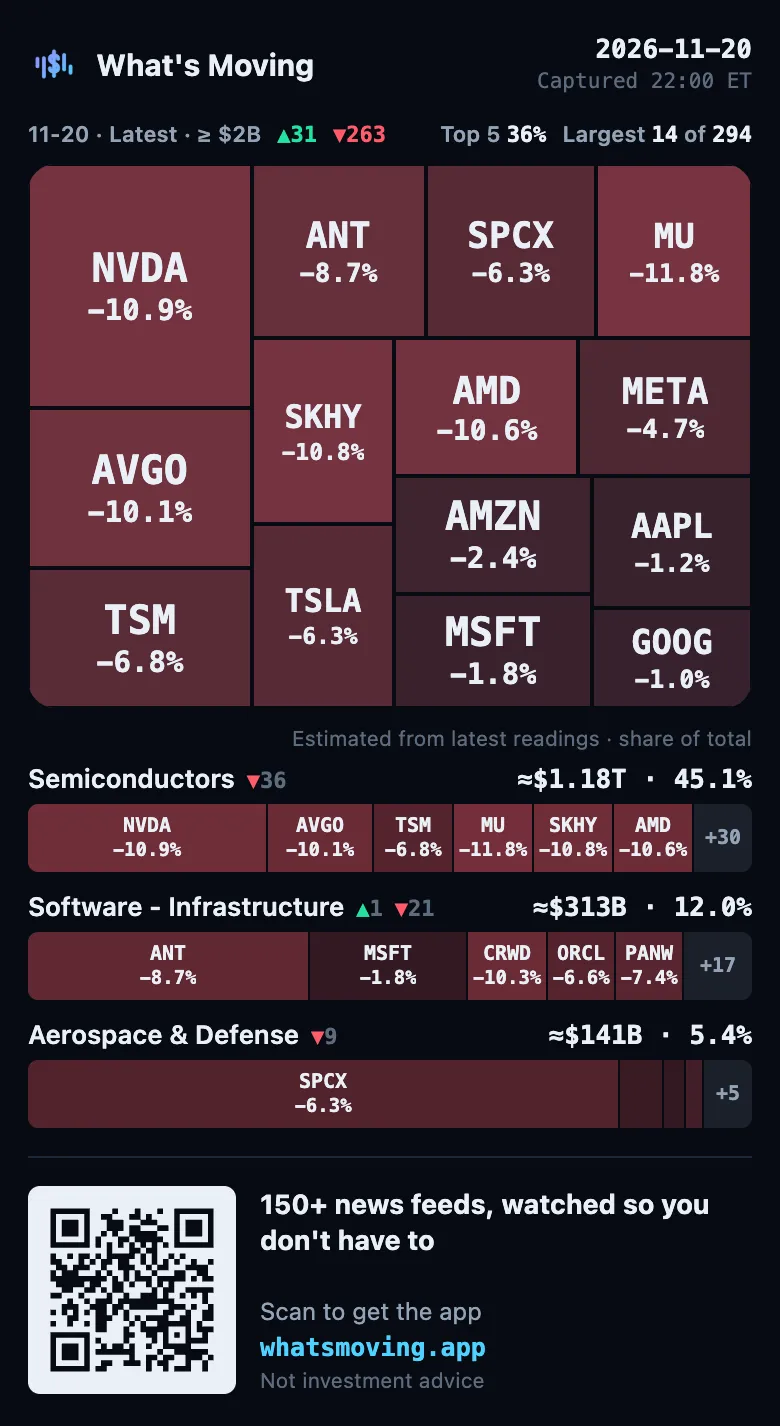
The heatmap shows after-hours prices; at its intraday low Nvidia was down 14.7%.
4. The timeline (ET; order isn’t causation)
Before this week
- Mid-October: Chamath Palihapitiya asked whether the AI buildout is creating a private-credit bubble, with a chart of a CoreWeave 2032 bond touching a 15% yield; per The Stack, Elon Musk replied “yikes”. CoreWeave fell 15.5% on Oct 14.
- Nov 5: the S&P fell 4.36% and chips 12%; fear of curbs on data centers after the midterms was one cause (earlier piece).
- Nov 6–13: October payrolls came in at 165,000 and October CPI rose 0.4% on the month. From the Nov 5 close to Nov 13 the 2-year yield rose 42bp, and the 10-year reached 5.15%. The Fed had already hiked in September; by Nov 13 a December hike was close to fully priced.
- Nov 11–12: Jensen Huang resigned as Nvidia’s CEO and director after the close on Nov 11, announced the next day. The 8-K gives no reason. Press reports cite affairs; the New York Times reported US officials believe one partner was a Chinese spy. CFO Colette Kress is interim CEO. Trump posted that Apple’s Tim Cook should take over: “A Legend to replace a Legend”. Nvidia opened down 13% on Nov 12 and closed down 4.3%.
- Nov 13: SemiAnalysis sent clients a model update cutting its 2030 AI accelerator capex forecast from $1.53T to $923B, with 66% of the cut wafer area falling on Nvidia. TIKR and Chinese financial media reported it.
- Nov 15 (Sunday): Treasury Secretary Bessent told Fox Nvidia needs “a dramatic shake-up” and the board should go outside the company for a CEO, asking whether it pressed “seemingly illicit sales” to China to goose its revenue.
Monday, Nov 16: the board says no (S&P -1.92%)
- Per CNBC, Nvidia’s board isn’t considering bringing Huang back. Trump told reporters he “would not mind” Huang returning. Commerce issued a rule closing the loophole that let Chinese firms rent Nvidia compute abroad. Nvidia fell 4.1%, the SOX 5.3%.
- Fed Governor Barr said the top seven AI firms’ on-balance-sheet debt will top $800B by year-end, with off-balance-sheet liabilities that could exceed $3T. Bloomberg reported CoreWeave’s bonds are in distressed territory, yielding close to 15%.
- Fed Chair Warsh spoke at the San Francisco Fed’s AI conference and steered clear of inflation and rates.
Tuesday, Nov 17: probes, a short, then a beat (S&P -1.03%)
- The WSJ reported an SEC civil probe of Nvidia’s disclosures, and California’s attorney general said he saw “red flags” (InvestmentNews). Muddy Waters disclosed a short on Nvidia. At 11:18, Huang posted that he’d be honored to return as CEO.
- St. Louis Fed President Musalem said several hikes may be needed before spring 2027. Stanley Druckenmiller told a conference in Austin he is short copper and close to flat on stocks.
- After the close Nvidia reported: revenue $115.8B vs $109.1B expected; Q4 revenue guidance $130B vs $125.3B; Q4 gross margin guided to 71–72%, down from 74.9% this quarter; licensed Hopper shipments to China stopped. Chair Harvey Jones said on the call the board “does not intend to reinstate Jensen as CEO”. The stock rose about 4% after hours.
Wednesday, Nov 18: the pop fades, hike talk gets louder (S&P -0.23%)
- Nvidia went from +4% after hours to a 2.9% loss.
- October FOMC minutes: “almost all” participants saw more hikes ahead, and a couple were open to 50bp. Waller said a 50bp hike is “probably necessary” and “You might need to, like, shock people.”
- Gold hit a 14-month low; copper had its worst day in 19 months.
- That evening Anthropic priced at $83, above the $70–78 range, for a valuation of about $1.5T. The public offering raised about $81B, more than SpaceX’s $75B base deal in June (SpaceX’s total with the greenshoe was $85.7B), making it one of the largest IPOs ever. A $26B private placement came on top.
Thursday, Nov 19: Anthropic lists, the market fades all day (S&P -2.02%)
- SPY opened up 1.3% and SMH up 3.4%, then slid all session; SPY closed 3.2% below its open.
- Anthropic opened at $111.50 and closed at $97.17, up 17%. CNBC said it was the most-traded stock among Vanguard’s self-directed clients that day.
- Chicago Fed President Goolsbee said the AI boom is adding to the potential for overheating, with inflation “borderline, disturbingly high”. Trump said of Iran, “We’ll see what happens after January 1.” Hunterbrook published a short report on AMD, which fell 7.7%. IBIT had a record $541M outflow.
- After the close, the House Foreign Affairs Committee released data showing about 879,000 Nvidia and AMD chips approved for China between December 2025 and May 2026, and California’s attorney general subpoenaed Nvidia.
Friday, Nov 20: two legs down (S&P -3.70%)
- Asia first: Taiwan -6.2%, Kospi -5.2%, Nikkei -5.1%. Nvidia opened down 1.6%; Anthropic was down about 9% premarket.
- 09:55: Ming-Chi Kuo posted that Google will shift about 1 million Broadcom-designed TPUs, roughly a fifth, to MediaTek-designed chips. Google hasn’t confirmed it. SPY was still up at this point.
- 10:00–11:05, leg one: Broadcom lost about 6% in half an hour and closed down 12%, with chips dragging the index down. At 10:31, Nvidia’s market value fell below Alphabet’s.
- 12:00–14:00, flat: Trump said US companies building AI data centers abroad would face a “tremendous tax”, and Fed Governor Cook said waiting longer on hikes risks falling behind the curve. Neither moved the tape.
- 14:05–14:35, leg two: the S&P broke below 7,000 around 14:15. Reuters reported exclusively that the SEC investigation is focused on Nvidia’s accounting; the earliest time I can confirm is CNBC’s 14:26, but the bars start falling at 14:05. Nvidia went from $135.70 to $129.
- After 15:19: the FT reported Trump is weighing new strikes on Iran, which CNBC said added late pressure. SPY touched -4.07% around 15:55. The VIX closed at 35.9.
- Close: Nvidia -14.0%, -22.9% on the week, its seventh straight weekly loss and the longest streak since 2008. Broadcom -12.2%, AMD -13%, Micron -14%. Anthropic -8.5%, with an intraday low of $83.05, right at its IPO price.
5. Every candidate cause (worth bookmarking)
The grouping is my call. Each item lists who reports it, the evidence for, and the evidence against.
Triggers: what got sold
- Nvidia’s trust problem (Nvidia, chips, the AI chain). Who: several major outlets (CNBC, Reuters, Bloomberg, WSJ). For: beat-and-raise, yet -23% on the week; Friday’s second leg lines up with the Reuters SEC story. Against: Nvidia was already down about 7% on the day before that story; the bars move about 20 minutes before the earliest time I can confirm; the SEC probe was reported Tuesday, and Friday’s news was only that it focuses on accounting.
- Google shifting TPU orders to MediaTek (Broadcom, chips). Who: one analyst, Ming-Chi Kuo, relayed by 24/7 Wall St and others. For: he posted at 09:55 and Broadcom fell hardest at 10:00–10:30, the start of leg one. Against: he describes a shift, not Google buying fewer chips; Google hasn’t confirmed; leg one ran over an hour and wasn’t only Broadcom.
Amplifiers: how hard it got sold
- Cash-out fears around Anthropic’s IPO (AI stocks, tech). Who: CNBC lists it first among Friday’s forces, writing that the debut fed fears of “a collective cash-out moment for the AI complex”; Bloomberg headlines mention it. For: +17% on day one, back at the IPO price intraday Friday; the most-traded name for retail on Thursday; about $81B raised plus a $26B placement in one week. Against: it’s one stock; whether it pulled money from other stocks, and how much, isn’t measured.
- Fed hike expectations (whole market). Who: several major outlets (CNBC, Reuters). For: Musalem, Waller, the minutes and Cook all leaned toward hikes, and Goolsbee warned of overheating; AP noted high rates make it harder for AI firms to borrow. Against: a December hike was about 90% priced before the week started and 50bp odds sat at 4–5% throughout; Warsh said nothing on rates; yields fell every day.
- Trend-following selling after the 200-day break (whole market). Who: one outlet (CNBC, quoting Jeremy Siegel: “a lot of trend riders… as soon as it goes down, they’re selling”). For: the S&P closed below its 200-day average (about 7,345) on Nov 17. Against: no dollar figures for this week.
- Options expiration (Friday). Who: strategist notes written beforehand only (SpotGamma; Nomura via Tickmill). For: Friday was monthly expiration; SpotGamma flagged 7,000–7,550 as a zone where dealers sell into declines, and the S&P spent most of Friday inside it. Against: no close-of-day story tied Friday to expiration; no size data.
- Cross-asset selling and margin calls (gold, copper, bitcoin). Who: one outlet (Investing.com on gold sold to meet margin calls). For: gold, copper and bitcoin all plunged the same week; bitcoin ETFs lost $1.13B in three days. Against: Deutsche Bank’s Ghali saw “remarkably limited evidence of large-scale outflows”; CFTC data through Tuesday still show funds net long gold.
- Iran (Friday’s last hour). Who: one outlet (the FT, cited by CNBC). For: the timing fits Friday’s final hour. Against: oil fell about 5% on the week; no close story blames the week on Iran.
The rest: background or local
- AI financing and payback (AI chain). Who: Barr’s speech text; Bloomberg on CoreWeave bonds (via Yahoo). For: Barr’s $800B and $3T; CoreWeave -26% on the week; neoclouds down 10%+ on Friday. Against: I found no big financing that fell through this week; the SemiAnalysis cut is a paid client report I couldn’t find in major English outlets.
- China chip curbs (chips). Who: Reuters, CNBC. For: Monday’s Commerce rule, Tuesday’s report of a plan to block Chinese data-center equipment, Thursday’s license data. Against: aimed mostly at Nvidia and AMD.
- Data-center politics (AI chain). Who: Fortune on Tuesday; AP’s Tuesday close story lists it as a cause; Reuters and CNBC as background. For: 40 of 41 local ballot measures went against data centers; New York froze hyperscale permits; Texas paused new grid hookups; Trump’s tax threat on Friday. Against: no new federal action this week; the Friday tax headline didn’t move the tape.
- Softer economic data (whole market). Who: commentary only; AP tied the data to falling yields, not to stocks. For: Empire State 7.8 vs 18 expected; Philly Fed 6.3 vs about 19; industrial production -0.4%; homebuilder sentiment lowest since 2012. Against: retail sales and housing starts beat.
Checked but not a factor this week: competition (doesn’t explain Nvidia’s 23% week), Asia selling first (it was reacting to Thursday), French debt, Japanese bonds (yields fell), private-credit blowups, tariffs and the Supreme Court, the debt ceiling and a shutdown (the government is funded to Dec 11).
6. What to watch next (worth bookmarking)
These test what comes next.
- Can Nvidia be trusted again: whether the SEC brings charges or a restatement follows; whether Huang returns and who becomes permanent CEO; Huang has agreed to testify before the Senate Banking Committee, date not set.
- Does the Fed keep pushing: the Dec 8–9 FOMC, 25bp or 50, and whether the statement or press conference mentions AI.
- AI chip orders: Broadcom reports after the close on Dec 9; listen for Google’s TPU orders.
- Anthropic: whether it holds its $83 offer price.
- Whether mechanical selling is done: the S&P back above 7,000 and its 200-day average; the VIX back under 30.
- AI financing: where CoreWeave’s bond yields go.
- Other dates: the Dec 11 government funding deadline; the Bank of Japan on Dec 17–18.
A prompt to give your AI
Use an AI that can browse, such as Claude Code or Codex. Next selloff, if you wonder whether someone is pushing the market down, fill in the blanks:
Help me find which players pushed in the same direction behind a selloff. Browse the web and read the original reports, not just search snippets, and don't answer from memory. Give a link and publish time for every fact; if you can't find something, write "not found". Attribution only; no buy or sell advice.

Period: ______ (e.g. Nov 16–20)
Hardest-hit sector: ______ (e.g. AI and chips)
Big event in the period: ______ (e.g. Anthropic's IPO)

1. List every player's moves in the period, by group: central bank speeches and minutes, regulators and Congress, the government, short sellers and analysts, big holders and new listings, fund flows. For each: who, what, date and time, exact words.
2. Mark each move's direction: does it make the sector more likely to rise or to fall? Then give the reason the player stated.
3. Check timing: do the moves cluster around the big event? Build a timeline and match it to the index's 5-minute bars: which headline lines up with which leg down.
4. Separate "same direction" from "coordinated": is there direct evidence the players coordinated, such as documents, investigations, on-record statements or credible reporting? If not, call it same-direction only.
5. List the other side too: moves pointing the opposite way, and legs down that match no headline.
6. End with: your read (marked as inference), how much weight each player carries, dates that will test it, and what evidence would prove you wrong.
To attribute a selloff cause by cause, use the prompt at the end of the earlier piece.
How I checked
Closes and 5-minute bars are from CNBC and Nasdaq, weights from SSGA’s SPY holdings, Treasury yields from the US Treasury, futures positioning from the CFTC’s weekly report. The S&P history since 1950 is CNBC’s data, checked against SPY from 2016. I don’t subscribe to Bloomberg, WSJ or FT, so I relied on rewrites by Reuters, CNBC, Yahoo and others, and I only saw Friday’s Reuters exclusive through other outlets. After drafting, I had AI check every line against the raw data, twice, and fixed what it caught.
Do you think someone pushed the market down this week, or did the AI trade just deflate on its own? Tell me in the replies.