I read Anthropic's S-1 so you don't have to: Claude writes 90% of its code, SpaceX sells it compute, and bans are in there (plus a prompt)
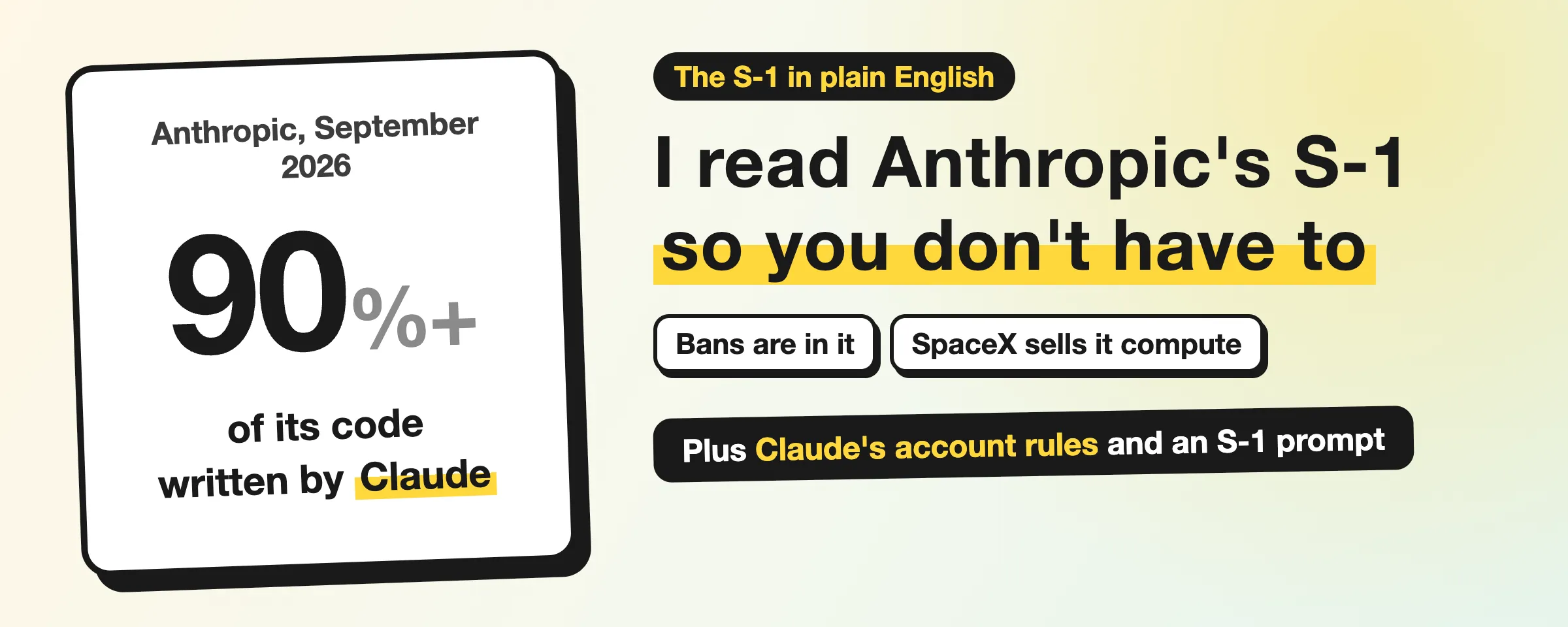
Anthropic's S-1 in plain English: bans, usage limits and outages, its compute deals with SpaceX, Google and Amazon, and Claude writing 90% of its code.
Anthropic’s S-1 went public on October 26. The body runs past 300 pages, and the coverage so far is about revenue and the size of the loss. If you pay for Claude, the parts that touch you are scattered through the risk factors.
I went through it line by line. What stood out:
- The filing says Anthropic stepped up enforcement in August and September. Customers it later found breaking its usage policy or commercial terms made up 5% to 7% of revenue in the first nine months of 2026.
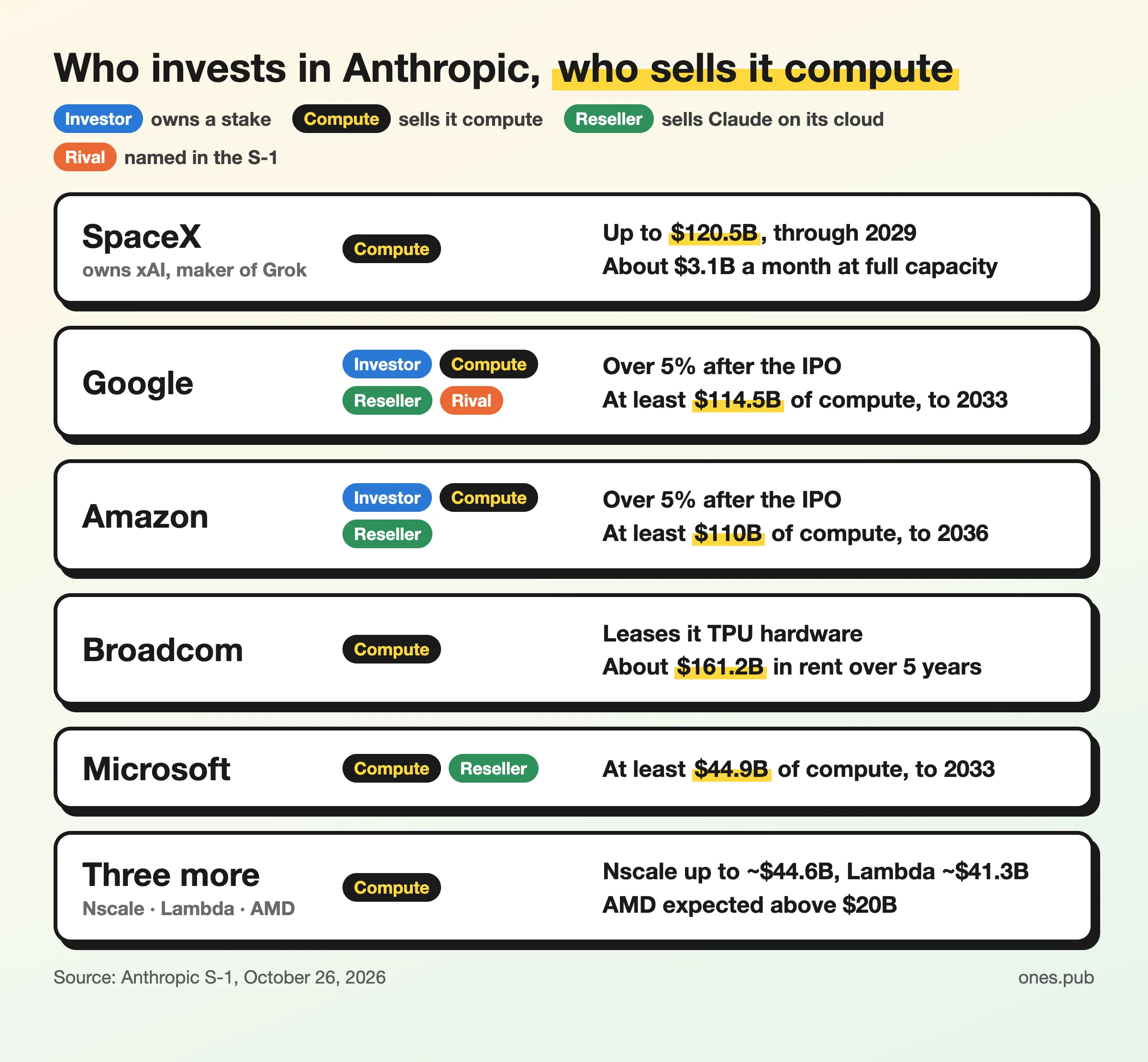
- SpaceX, which now owns xAI, the company behind Grok, sells Anthropic compute: up to $120.5 billion through 2029, about $3.1 billion a month once all of it is delivered.
- Over 90% of the code contributed to Anthropic’s codebase in September was written by Claude.
- In early 2025 it spent $2.51 on compute for every dollar of revenue. By mid-2026 that was 48 cents.
At the end there’s a checklist of Claude’s account rules and a prompt that makes Claude Code or Codex read any S-1 the same way. Whether to buy on day one is a separate question, and I ran the numbers on 48 tech IPOs for that.
What it says about you, the Claude user
Bans: enforcement went up in August and September
The filing says some revenue comes from customers Anthropic later finds violating its usage policy or commercial terms, about 5% to 7% for the nine months to September 30, 2026. It says it enhanced detection and enforcement “in particular in August and September 2026” and expects that share to fall, even though that may slow revenue growth.
Two more admissions: enforcement takes time, and people whose access is cut “may re-register under new accounts.”
The filing does not say who those customers are or what they did, so don’t pin every recent ban on it. What gets an account banned is in the rules checklist at the end.
Usage limits: changed before, may change again
“We have also changed, and may in the future change, usage limits, rate limits, or model and product capabilities.” Some of those changes led to claims that its disclosures about model access or capabilities “were inadequate or misleading.”
Today Pro and Max both have a five-hour session limit plus a weekly limit, shared between Claude and Claude Code. The filing describes subscribers who hit their cap and move to a higher tier or pay per use as a revenue path.
Outages: March was partly a demand spike
The March 2026 outage and slowdowns came from, among other things, “a significant and rapid increase in usage demand” and compute constraints in parts of its infrastructure. Anthropic says it has consistently operated in a compute-constrained environment, and it books compute 12 to 18 months ahead.
More is on the way. The SpaceX capacity is expected to be fully delivered in December; part of the TPU hardware leased from Broadcom came online this year, with more from 2027; and the first AMD tranche lands in 2027 too.
A model can go dark overnight
In June 2026 the US Department of Commerce put worldwide export restrictions on Fable 5 and Mythos 5. Anthropic disabled both for every customer to comply; other models kept working. It brought them back after updating its safeguards and once the restrictions were lifted. The filing says similar controls could come back.
Old models may stick around longer
Considerations around model safety, interpretability, alignment and welfare “may lead us to limit or delay the deprecation of older models.”
It keeps getting cheaper
Fable 5.1, released in September, cut the cost of typical workloads by about 25% versus Fable 5, and up to 45% for complex coding and agentic tasks. Opus 5.5 cut cost per task by about 40% versus Opus 5. Part of that is lower prices, part is the newer models doing the work more efficiently.
Who’s who: SpaceX, Google, Amazon, Broadcom
Some of these companies invested in Anthropic, some sell it compute, some resell Claude on their clouds, and Google is also a named competitor.
SpaceX: Grok’s owner powers Claude
- SpaceX completed its acquisition of xAI on February 2, 2026.
- On May 6, xAI announced Anthropic would get access to Colossus 1, more than 220,000 NVIDIA GPUs, to serve Claude Pro and Max users.
- Per the S-1, between May and October Anthropic signed several agreements with SpaceXAI (formerly X.AI) for NVIDIA GPU compute: up to $120.5 billion through 2029, about $3.1 billion a month once all capacity is delivered, expected in December 2026. After non-cancelable periods ending in early 2027, either side can cancel on 90 days’ notice.
- SpaceX’s Q3 report on October 20 showed its AI segment (SI) at $7.56 billion in revenue, up 830% year over year. Its 10-Q lists one unnamed customer at 34.5% of SpaceX’s Q3 revenue, about $5 billion, all in that segment. NBC reported SpaceX’s compute customers include Anthropic, Google and Reflection AI. Neither SpaceX filing says whether that customer is Anthropic.
The S-1 names only two primary competitors, OpenAI and Google. xAI isn’t one of them.
Google: investor, supplier, reseller and rival
- It will own more than 5% after the IPO (the exact figure is left blank), and it has an option to buy up to $10 billion more at the IPO price.
- Anthropic committed to spend at least about $114.5 billion with Google from April 2026 to July 2033, “regardless of actual usage,” plus an estimated $125 to $150 billion of additional TPU compute from Google and other TPU providers in 2028 to 2031.
- Claude is sold through Google Cloud’s AI platform.
Amazon: investor, supplier, reseller
- More than 5% after the IPO.
- At least $110 billion from May 2026 to April 2036, regardless of usage. Anthropic also uses Amazon’s own Trainium chips.
- Claude is sold through Amazon Bedrock.
Broadcom, Microsoft and the rest
- Broadcom leases Anthropic TPU-based hardware: about $161.2 billion in rent over five-year leases. If needed, Anthropic can also issue Broadcom up to $42 billion in convertible notes, solely to pay that rent.
- Microsoft: at least $44.9 billion from November 2026 to May 2033, regardless of usage. Claude is also sold through Microsoft Foundry.
- Nscale up to about $44.6 billion, Lambda about $41.3 billion, AMD expected above $20 billion.
Adding up Broadcom, SpaceX, Google, Amazon, Microsoft, Nscale and Lambda gives about $637 billion, before the 2028 TPU purchase and AMD.
Close to half of Anthropic’s revenue goes through the AWS, Google and Microsoft cloud marketplaces: 47% in 2025, 48% in the first half of 2026.
Claude writes 90% of the code
- In September 2026, “over 90% of the contributions to our codebase” were written by Claude.
- Code contributed per engineer per day in Q3 was more than 45 times the 2024 average.
- Over the past year revenue grew about 1,200% while headcount grew about 170%. Revenue per employee went from $1.4 million to over $6.6 million.
- Its models “increasingly perform our research, including our safety research.”
On the people side:
- Two tender offers let employees and early holders sell: $5.61 a share in June 2025 and $25.91 in April 2026, 4.6 times the price ten months earlier. Dario and Daniela Amodei sold some shares both times.
- The co-founders have each pledged 80% of their Anthropic equity to philanthropy.
- The company put 5% of its shares into its own Public Benefit Fund, and can add up to 2% more each time the share price rises 50%.
How it makes money, and where the money goes
- In the first half of 2026, 80% of revenue was usage-based (the API, billed by token). The other 20% is subscriptions.
- About 40 million customers each paid it less than $100,000 over the trailing year. More than 1,900 paid over $1 million.
- The top five customers were about 25% of revenue for the nine months, and none was over 10%.
- Over 80% of Q3 revenue came from model versions released in the prior six months.
- Among Claude Enterprise users, the top 5% of Claude Code users spent about 20 times as much as those who don’t use Claude Code, who averaged under $75 a month.
- Cowork is being adopted faster than Claude Code was at the same point, and in September Anthropic began merging Cowork and Claude.ai into one app.
Quarterly compute spending went from $944 million in Q1 2025 to $5.6 billion in Q2 2026. Revenue grew faster, so compute fell from 251% to 48% of revenue.
Revenue, the loss and the IPO timeline are in the day-one piece.
Claude account rules (save this)
From Anthropic’s supported regions page, consumer terms, usage policy and help center:
- Use it only from a supported country or region. Using it while physically in an unsupported region, or signing up from one, breaks the rules.
- You must be 18 or older.
- Your account is yours alone. Don’t share logins or API keys.
- No bots or scripts driving claude.ai. Automate through an API key.
- No reselling. Third-party apps may not route requests through your Pro or Max login or credentials on behalf of their users.
- Don’t use Claude’s outputs to train a competing model.
- Using a new account to get around a ban is itself a violation, per the usage policy taking effect November 12.
- If you’re banned: log in at claude.ai with the banned account and submit the appeal form. You can still log in to export your data or delete the account. If you were banned for a violation, you don’t get a refund.
A prompt for Claude Code or Codex
Open an S-1 on the SEC site, save the page as a file into an empty folder, open Claude Code or Codex in that folder, and paste:
Read this US IPO prospectus (S-1) and explain it to someone with no finance background. The file is in the current folder.
It's long, so don't load it whole: convert it to plain text, list the table of contents, then search by keyword for each question below and read the matching passages.
1. In five plain sentences: how it makes money, how much revenue and how fast it's growing, whether it's profitable, where the money goes, and who controls the company.
2. Its relationships with big companies: who invested, who sells it compute, chips or cloud, who resells its products, and which competitors it names. Give the amount and term for each.
3. Terms an ordinary user will run into: bans and violations, usage limits, outages, products being shut off, privacy and data, age, price cuts or increases.
4. The five most surprising numbers.
5. After each point, quote the original sentence and the section it's in. If the filing doesn't say something, say "not stated" and don't guess. If a number is left blank (just $ or %), say "left blank".
6. Finally, the three risk factors most likely to affect ordinary users.
It works on the next filing too. When OpenAI’s S-1 goes public, swap the file.
How I read it
- I downloaded the S-1 from the SEC, split it into one sentence per line, and searched it by topic (users, partners, people, revenue, costs). Every number traces back to a sentence in the filing.
- I don’t fill in what the filing leaves out, such as who the 5% to 7% are, or whether SpaceX’s big unnamed customer is Anthropic.
- The $637 billion is my own sum; the filing leaves the total blank. SpaceX and Nscale are maximums, and Broadcom is lease rent.
- Both tender prices are adjusted for the 10-for-1 split in September.
- The account rules come from Anthropic’s site and help center, read on October 26.
- If I misread something, tell me in the replies and I’ll fix it.
Sources:
- Anthropic S-1
- SpaceX Q3 2026 earnings release
- SpaceX Q3 2026 10-Q
- xAI: compute partnership with Anthropic
- NBC: SpaceX quarterly revenue jumps on data centers
- Anthropic supported countries and regions
- Anthropic consumer terms
- Anthropic usage policy
- Claude Code legal and compliance
- Help center: safeguards warnings and appeals
- Help center: Claude Code with Pro or Max
Which of these surprised you most?