Should you buy the Anthropic IPO on day one? I ran 48 big tech IPOs bought at the open (plus the unlock calendar)
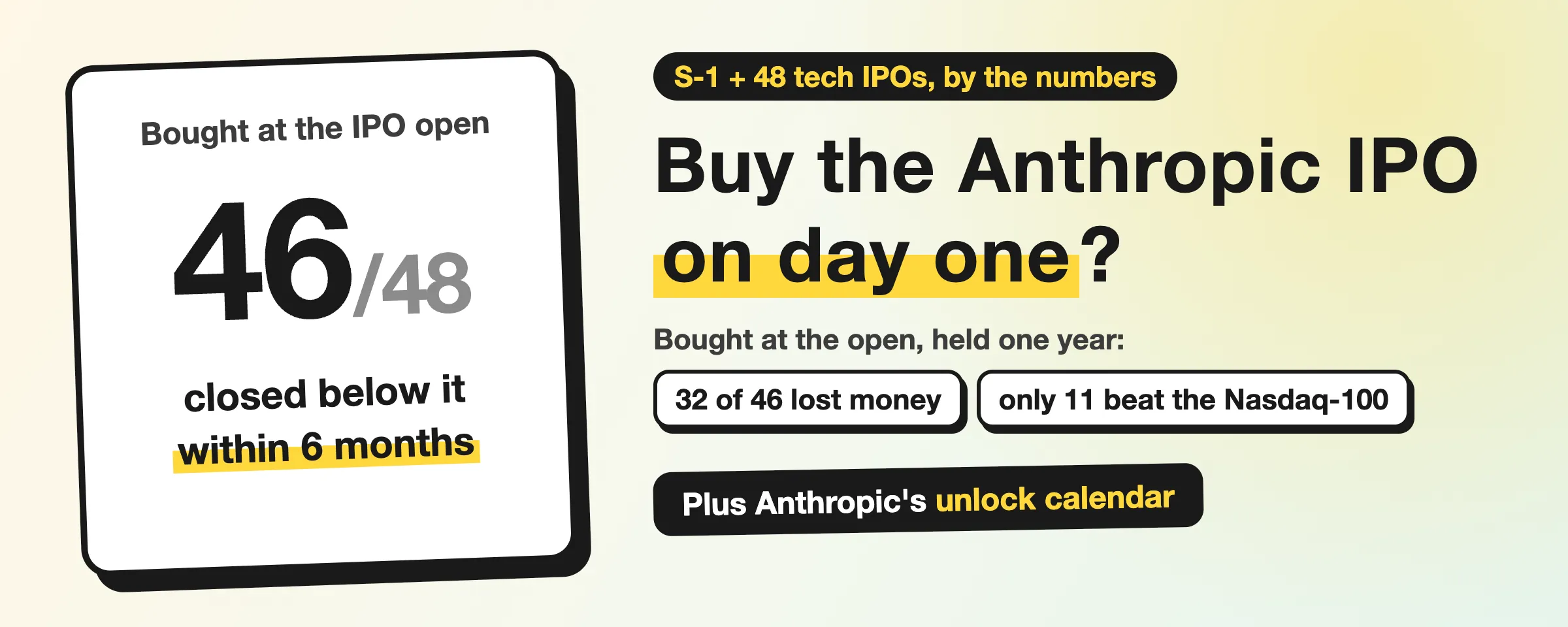
Should you buy the Anthropic IPO on day one? Of 48 US tech IPOs bought at the open, 46 closed below that price within six months and 32 were down a year later.
Update, November 11: On November 10 Anthropic set its IPO range at $70 to $78 a share, about $1.40 trillion fully diluted at $78, 21 times annualized Q3 revenue and 17 times the October run-rate, below the roughly $2 trillion and 30 to 43 times this piece estimated from reports. The filing now says up to 20% of the shares will go to retail investors through brokers including Schwab, Fidelity, Robinhood, SoFi and E*TRADE. Whether that price is worth it, and how much revenue it needs by 2030, is in the new piece.
Anthropic made its prospectus public on October 26 and plans to list on Nasdaq under the ticker ANT. Media reports say the earliest listing is mid to late November; the date is not set.
If your plan is to buy on day one, history has a few things to say. I pulled the data for 48 large tech IPOs since 2012 and assumed a buy at the open on listing day:
- 46 of the 48 closed below your buy price at some point within six months. For the median company, the low in those six months was 30% under the open.
- Hold a full year and 32 of 46 lost money. Only 11 beat the Nasdaq-100 (the index QQQ tracks) over the same year.
- Of the 40 companies listed at least 3 years, only 4 beat the Nasdaq-100 through today: Meta, AppLovin, Robinhood and Arm.
The numbers in Anthropic’s prospectus are excellent, and I cover them below. The part that hurts buyers is the day-one price.
This piece covers four things: how the company is doing, why lower prices usually came after listing day, which days after listing are worth watching (with a calendar you can bookmark), and what to know before you buy.
The short version
- Buy at the open on IPO day and, historically, almost every time a cheaper price showed up within six months. Only 2 of the 48 never closed below their day-one open. But nobody knows which day the low lands on, and splitting your buys was cheaper only a little over half the time.
- Big companies suffer less from the day-one price. In Ritter’s large sample, companies with more than $1 billion in annual revenue lagged the market by only 2 percentage points over 3 years when bought at the day-one close. The first year after listing is where buyers get hurt most.
- Three things to watch with Anthropic: very few shares trade at first; unlocks start in week 4 after listing; and after 15 trading days it gets added to the Nasdaq-100.
- Outside the US, you may be able to apply for shares at home: the prospectus lists public offerings in Australia, Canada, certain EU countries, Japan, Switzerland and the UK.
The numbers in the prospectus
The company first:
- Revenue: $41 million in all of 2023, $386 million in 2024, $4.59 billion in 2025. In the first half of this year it made $16.29 billion, 3.5 times last year’s full year in six months.
- Q2 revenue was $11.56 billion, up 1,368% from a year earlier, about 15 times as much. Bloomberg and Reuters report that the company told investors Q3 revenue was $16.8 billion (that line is still blank in the prospectus).
- Margins are high. In the first half, direct costs (mostly computing power) ran about $15 for every $100 of revenue; I worked that out from the revenue and cost figures in the prospectus. Q2 was its first quarter with an operating profit, $974 million. In the first half, the business itself brought in $3.9 billion more cash than it spent.
- Customers: those paying $100,000 or more a year went from just over 950 a year ago to over 11,900 now. About 250 pay $10 million or more a year.
- Existing customers keep spending more. The same group of business customers (excluding Pro and Max personal subscriptions) spent about 9 times as much last quarter as in the same quarter a year earlier.
- No cash worries: $112.4 billion in cash at the end of June, plus $19.3 billion in short-term investments.
You may have seen “lost $80.7 billion in the first half.” Of that, $72.4 billion is a paper loss from re-pricing instruments such as convertible notes the company issued early on (debt that can turn into shares), at its new valuation. The more the company is worth, the bigger that number gets. It is not cash that went out the door.
If you have used Claude, these numbers will not surprise you. Next: what you would pay for it on day one.
Four things about this stock
First, the price is not cheap. The last funding round, in May, valued it at $965 billion. Media report a target valuation of around $2 trillion at listing, more than double the May figure, five months later.
At Q2’s pace, a year of revenue is about $46 billion; at the reported Q3 pace, about $67 billion. A $2 trillion valuation is 30 to 43 times that annual revenue. The price already counts on several more years of fast growth. The prospectus says so itself: “We expect our revenue growth rate to decline over time, and it may decline significantly and more rapidly than we anticipate.”
Second, owning shares gives you almost no say. The public buys Class A shares. All Class A shares together are capped at 49.9% of the votes. One Class F share, held jointly by the 7 co-founders, always carries 50.1%. A majority of the board is chosen by an independent “Long-Term Benefit Trust.”
Third, the company does not run only for shareholders. Anthropic is a public benefit corporation. Its directors must balance shareholders’ interests, the interests of the people the company affects, and its mission. In the prospectus’s words, this “may conflict with short-, medium-, or long-term financial interests and business performance, which may negatively impact the value of our Class A common stock.”
Fourth, few shares trade at first. The number of shares on offer is still blank in the prospectus. From the reported raise (over $100 billion) and the valuation, the shares sold come to about 5% of the total. SpaceX also sold under 5%.
With so few shares, a handful of big orders can push the day-one price very high. Professor Jay Ritter of the University of Florida has the numbers: IPOs that offer less than 10% of the shares rose 32% on average from offer price to the first close; those offering more than 40% rose only 8%.
Three prices on day one
The offer price is set the night before listing. Only people who win an IPO allocation get it, and most of it goes to institutions. The prospectus does not promise retail investors any amount. It says only that the underwriters (the banks running the sale) “may” give some to customers of their own online brokers.
The opening price. On listing day you cannot buy the moment the market opens. The exchange first matches the buy and sell orders, and the first trade often comes around midday. SpaceX priced at $135 and opened at $150, and the first trade came before noon. Before the open, brokers cannot take market orders for a new issue (FINRA Rule 5131, the US brokerage regulator’s rule). You can only place a limit order, which sets the most you are willing to pay.
The first closing price is the price at the end of day one.
Ritter counted more than 9,300 US IPOs from 1980 to 2025. From offer price to first close they rose 19% on average, and tech stocks rose 31%. That jump belongs to the people who won allocations. Most people who say they “bought right away” bought at the open, which is exactly where that jump ends.
Some recent cases: Figma priced at $33, opened at $85, and was around $24 a year later. Cerebras listed this May at $185, opened at $350, and closed at $111 on October 23, 68% below its open and 40% below its offer price.
How 48 companies did after a buy at the open
I picked tech and internet companies that listed in the US since 2012, raised roughly $1 billion or more, and still trade today. That is 48 companies, including Meta, Alibaba, JD.com, PDD, Uber, Airbnb, Arm, CoreWeave, Figma and SpaceX. Every case assumes a buy at the listing-day open.
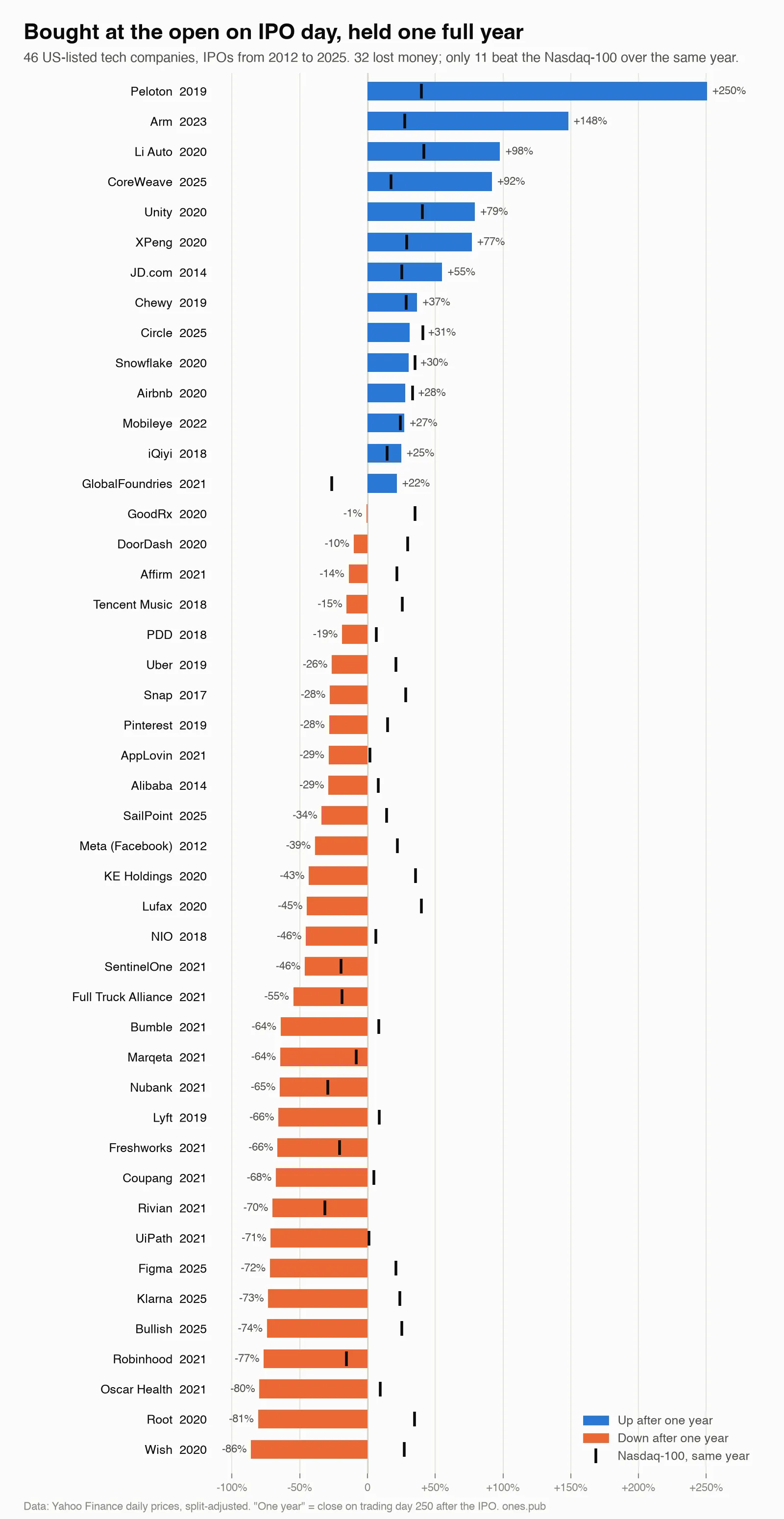
Results come in three stretches:
Within six months: 46 of 48 fell below the buy price at some point. For the median company, the low in six months was 30% under the open. Only Pinterest and Lufax never did.
After one year: of the 46 with a full year of data, 32 lost money, and the median company was down 29%. Only 11 beat the Nasdaq-100 over the same year.
Through today: of the 40 listed at least 3 years, 11 are above the buy price and 4 beat the Nasdaq-100.
Meta is the best example. Its 2012 open was $42.05. A little over three months later it had closed as low as 58% down, and a year in it was still 39% down. Held to today it is up more than 14 times, against about 12 times for the Nasdaq-100 over the same period. You can pick the right company and still have to sit through a drop of more than half first.
Ritter’s 9,300 IPOs show the same pattern. Buy at the first close and hold 3 years, and the average IPO company trailed the market by 20.5 percentage points over that time, tech by 12.7. Large companies with more than $1 billion in annual revenue did better, trailing by only 2.1 points, and Anthropic belongs to that group. But in the first year after listing, IPO companies rose 5.6% on average, against 11.4% for established companies of the same size.
Why stocks tend to fall after listing
The day-one gain has already been taken. The open already includes the jump that allocation winners made.
More people can sell. Shares that early holders were locked out of selling become sellable when the lock-up (a promise not to sell for a set time) ends. Academic work (Field and Hanka, 2001, nearly 2,000 unlocks) found stocks fell an extra 1.5% on average in the 3 days around an unlock, and trading volume stayed 40% higher afterward.
The buzz is a one-time event. Index fund buying, underwriter analysts’ first reports and media coverage all bunch into the first month, then stop.
The nearest example to Anthropic is SpaceX:
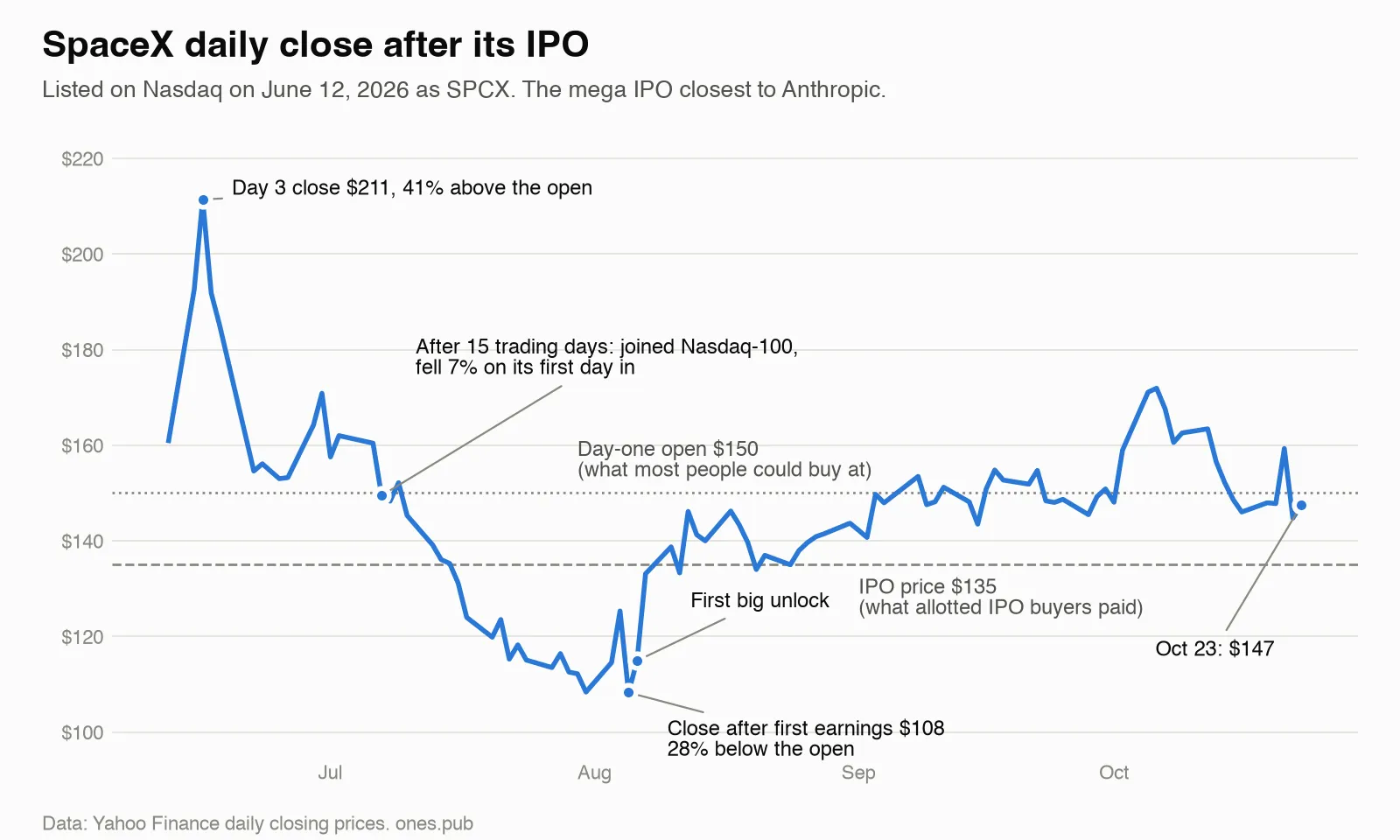
SpaceX listed on June 12 at $135 and opened at $150. On day 3 it closed at $211, 41% above the open. After 15 trading days it joined the Nasdaq-100 and fell 7% on its first day in. Its first earnings came after the close on August 4, and the next day it closed at $108, 28% below the open. On August 6, the day of the big unlock, it rose 6%. On October 23 it closed at $147: anyone who bought the day-one open is still not back to even four months on.
Anthropic’s calendar after listing (bookmark this)
Dates are worked out from the prospectus and the index providers’ rules. The listing date is not set, so go by the announcements when they come.
- Listing day: the open has to wait, and you can only place limit orders. Some executives and employees can sell up to 10% of their shares that day.
- After 5 trading days: large IPOs join the Russell indexes, and funds that track them have to buy.
- After 15 trading days: if its market value ranks in the Nasdaq-100’s top 40, it is added. At the reported valuation Anthropic is far above that bar. Nasdaq-100 trackers buy all at once at the close the day before it joins; SpaceX fell 7% on its first trading day after joining.
- About day 25 after listing: by convention, the underwriters’ analysts start publishing research reports.
- Days 27, 48, 62 and 76 after pricing (roughly weeks 4, 7, 9 and 11 after listing): most early shareholders unlock in four batches, each 6%, 6%, 7% and 7% of their locked shares. Holders of more than 0.5% of the company get 1.8% to 2.1% per batch.
- After the 2026 annual report (early 2027, most likely the first report after listing): executives and employees get another 35%, other early shareholders another 12.5%, then about every two weeks another 9.5%, five times in all.
- After the Q1 2027 report, or 180 days after listing, whichever comes first: executives, employees and most early shareholders are fully unlocked. The 7 co-founders can sell up to 29%.
- After the Q3 2027 report, or 365 days: founders and large holders are fully unlocked.
- S&P 500: it must be listed at least 12 months, and both the latest quarter and the last four quarters combined must be profitable under accounting rules. In June, S&P explicitly declined to relax those two rules for very large IPOs.
Also, underwriters Goldman Sachs and Morgan Stanley can release any batch early at any time.
What to know before you buy
Check where you can apply. Besides the US, the prospectus lists public offerings in Australia, Canada, certain EU countries, Japan, Switzerland and the UK. In some EU countries there is a separate offering for ordinary investors, under its own European prospectus. In the US, the underwriters “may” set shares aside for the online brokers they work with; the prospectus names none.
An IPO allocation gets you the offer price, but very few shares. At Robinhood, a US broker, winners are drawn at random from applicants, and applying for more does not raise your odds. Selling within 30 days counts as flipping and can cost you IPO access for 60 days.
At the open you can only use a limit order. Decide before you click the most you will pay. Day one is wild: Circle and Figma were both halted on listing day for rising too fast.
Splitting your buys does not guarantee a cheaper price. I tested that too: split the money into 5 parts and buy one on trading days 16, 25, 40, 80 and 125 after listing. Across the 46 companies, only 25 had an average cost below the day-one open, and the median saved 9%. On stocks that kept climbing, like CoreWeave and Circle, the split-buy average cost came out more than double the open.
Decide whether you can sit through the drop. Meta fell as much as 58% within a year. Cerebras fell 68% in five months.
You may already own a little indirectly. Amazon has invested about $18 billion in total, and in the first half of this year its “other income” was $69.1 billion, mostly from Anthropic’s rising valuation. Google, by the several agreements the prospectus discloses, has put in about $23.3 billion in total.
Avoid anyone selling shares before the IPO. Anthropic has said publicly that holding its stock through an SPV (a special-purpose vehicle, a shell that pools investors’ money) is not allowed and any transfer to an SPV is void. Anyone selling its stock through tokens, forward contracts and the like is “likely either engaged in fraud or offering an investment that may have no value.”
Prompt to paste into your AI
Paste this into Claude Code or Codex. It will build this table for any new listing and lay out the unlock calendar:
Help me judge how a newly listed US stock has done historically if you buy at the open on listing day.
1. Download daily prices (open and close, adjusted for splits) from Yahoo Finance for these tickers since each one's IPO: <tickers, separated by spaces>. Also download QQQ for the same period.
2. For each stock, use the first day's open as the buy price and calculate:
   - how far the lowest close in the first 125 trading days was below the buy price;
   - the change in the close on trading days 20, 60, 125 and 250 against the buy price;
   - the change in QQQ over the same stretches;
   - the change up to the latest trading day, compared with QQQ over the same period.
3. Yahoo prices are already split-adjusted, so convert the offer price by the same split ratio before comparing. Where the first day's data is missing, fill in the open reported in the news and flag it.
4. Output one table, then summarize in three sentences: how many fell below the day-one open within six months; how many lost money after a year and how many beat QQQ; and, for stocks listed at least 3 years, how many beat QQQ through today.
5. Then open the latest S-1 or 424B4 for <company name> on SEC EDGAR and find the offer price range, the number of shares offered, the lock-up period, and the date and share of every early release. Lay them out as a calendar counted from listing.
How I calculated this
- Sample: tech and internet companies listed in the US since 2012, raising roughly $1 billion or more, and still trading on October 23, 2026. 48 companies. I picked them from a list, so it is not a random sample. Companies since delisted or acquired (Twitter, Didi, Qualtrics, HashiCorp, for example) are left out. For Twitter and Didi, which I could check, both traded below their day-one open a year after listing.
- Prices: Yahoo Finance daily data, adjusted for splits. Klarna’s first day is missing on Yahoo, so I used the open and close reported in the news, $52 and $45.82. “Six months” means trading day 125 after listing and “one year” means day 250. The Nasdaq-100 is measured with QQQ, from the close the day before listing. A dip below the buy price is judged on closing prices. SpaceX and Cerebras have not been listed six months yet, so their figures run to October 23.
- Large sample: Jay Ritter’s US IPO statistics, October 2026 edition.
- Prospectus: the S-1 made public on SEC EDGAR on October 26, 2026. The “$15 of cost per $100 of revenue” figure is my own calculation from the prospectus numbers. Q3 revenue, the listing valuation and the amount raised come from Bloomberg, Reuters and New York Times reports; those lines are still blank in the prospectus.
- This is a data write-up and not investment advice.
Sources:
- Anthropic S-1 prospectus
- Jay Ritter IPO data
- S&P Dow Jones Indices: results of the mega-cap treatment consultation
- New Nasdaq-100 fast-entry rules (BNN Bloomberg)
- Russell index IPO fast entry (LSEG)
- Robinhood IPO Access rules
- FINRA Rule 5131 FAQ
- Anthropic’s warning on private share transfers (CoinDesk)
- Amazon Q2 2026 10-Q
Will you buy Anthropic on day one, or wait? Tell me why.